
 Posts
Posts


“Degrees of ability vary, but the basic principle remains the same: the degree of a man’s independence, initiative and personal love for his work determines his talent as a worker and his worth as a man. Independence is the only gauge of human virtue and value. What a man is and makes of himself; not what he has or hasn’t done for others. There is no substitute for personal dignity. There is no standard of personal dignity except independence.Excerpt from The Fountainhead, by Ayn Rand
“In all proper relationships there is no sacrifice of anyone to anyone. An architect needs clients, but he does not subordinate his work to their wishes. They need him, but they do not order a house just to give him a commission. Men exchange their work by free, mutual consent to mutual advantage when their personal interests agree and they both desire the exchange. If they do not desire it, they are not forced to deal with each other. They seek further. This is the only possible form of relationship between equals. Anything else is a relation of slave to master, or victim to executioner.
“No work is ever done collectively, by a majority decision. Every creative job is achieved under the guidance of a single individual thought. An architect requires a great many men to erect his building. But he does not ask them to vote on his design. They work together by free agreement and each is free in his proper function. An architect uses steel, glass, concrete, produced by others. But the materials remain just so much steel, glass and concrete until he touches them. What he does with them is his individual product and his individual property. This is the only pattern for proper co-operation among men.
...
“Now observe the results of a society built on the principle of individualism. This, our country. The noblest country in the history of men. The country of greatest achievement, greatest prosperity, greatest freedom. This country was not based on selfless service, sacrifice, renunciation or any precept of altruism. It was based on a man’s right to the pursuit of happiness. His own happiness. Not anyone else’s. A private, personal, selfish motive. Look at the results. Look into your own conscience.
“It is an ancient conflict. Men have come close to the truth, but it was destroyed each time and one civilization fell after another. Civilization is the progress toward a society of privacy. The savage’s whole existence is public, ruled by the laws of his tribe. Civilization is the process of setting man free from men.
“Now, in our age, collectivism, the rule of the second-hander and second-rater, the ancient monster, has broken loose and is running amuck. It has brought men to a level of intellectual indecency never equaled on earth. It has reached a scale of horror without precedent. It has poisoned every mind. It has swallowed most of Europe. It is engulfing our country.
Showing posts with label self-sufficiency. Show all posts
Showing posts with label self-sufficiency. Show all posts
Wednesday, March 4, 2009
The Defense of Howard Roark

Saturday, January 31, 2009
How to Dry Foods
 How to Dry Foods. Deanna DeLong. Recommended.
A food dehydrator was on my Christmas list this year, and as luck would have it, one appeared under the tree. A fairly comprehensive instruction manual accompanied the dehydrator, but I thought I would look for more guidance. This book seems to be a complete guide for home food drying. All major foods are covered: fruits, vegetables, meats, herbs, spices, nuts, and seeds. Not only does the text list foods that are great for drying, but it cautions against others that are only marginal. This will save countless hours of fruitless trial and error.
The recipe section has many jerky marinade formulations and fruit leather mixtures. Also included are many recipes that use the dried products, so you know what to do with all the things you have preserved.
I would highly recommend this if you are interested in food dehydration. Thus far I have made some pretty decent beef jerky and dried pineapple. Perhaps as I gain more skill I will post some of my favorite recipes.
Tuesday, October 14, 2008
Green Jobs Examined

Here is an interesting take on the "green jobs" sector that is referenced so much about in the presidential campaigns. It is from Energy Outlook...which I recommend quite highly.All Those Green Jobs
A full-page ad appearing in today's New York Times, Wall Street Journal, and Washington Post reminded me of a topic I've meant to cover for some time. Frequently during this election campaign, including the primaries, we have heard candidates extol the employment benefits of a switch to renewable energy. In Tuesday night's debate, Senator Obama suggested a figure of "5 million new jobs" from clean energy, and Senator McCain also mentioned "millions of jobs" in this context. It sounds alluring. A rapidly-growing energy sector providing good jobs here in the US is just what the economy could use at the moment. But while recognizing the potential benefits, we should also examine these claims critically. What would 5 million green energy jobs imply about future US energy costs and competitiveness?
The ad in today's papers is entitled, "The Unshaken Pillar", and it describes the US energy sector as a solid foundation for the whole economy at a time of great uncertainty, emphasizing the need for improved energy efficiency and conservation, along with expanded production of both oil & gas and alternatives. Signed by the CEOs of Chevron, AEP, FedEx, and Dow Chemical, it cites employment as an example of the domestic energy industry's benefits. This suggests a basis for putting those hypothetical 5 million green jobs into perspective. As of last year, the US oil and gas industry employed 1,772,000 workers in all categories, spanning exploration & production, refining, transportation and distribution. Nor are they all engineers and highly-paid drilling specialists. Nearly half this figure was associated with employment in service stations. Collectively, these 1.8 million people produced, processed and delivered fuels carrying 33 quadrillion BTUs of energy, or "quads", to US consumers and businesses. That's a third of total US energy consumption and 46% of US energy production. On average, it equates to 18.6 billion BTUs per worker, or 3,100 barrels of oil equivalent each, annually.
In order to come up with a comparable productivity metric for renewable energy, we need to make some assumptions about how much this sector will produce when it reaches its anticipated employment of 5 million Americans. It must be a lot more than the 1% or so of electricity and 7% of gasoline currently supplied by wind, solar power and ethanol. If we combine the 36 billion gallons per year of biofuel targeted for 2022 under the federally-mandated Renewable Fuel Standard with the 20% of net electricity generation from wind by 2030 posited by a recent DOE study, as a proxy for all new renewable electricity, the total equates to roughly 14 quads per year. And that's giving the kilowatt-hours from renewable electricity the benefit of a gas-fired turbine heat rate, rather than the normal engineering conversion, which is 2/3 lower. The resulting productivity figure works out to 2.8 billion BTUs per green energy worker, or 470 barrels of oil equivalent per year.
On that basis, we should expect that the average energy productivity of this huge new renewable energy sector would only be about 15% of the productivity of the current oil and gas industry. To understand the implications of that for the economy and for US international competitiveness, we must translate these figures into dollars. If the average "green-collar" job envisioned by those emphasizing the employment benefits of renewable energy pays the current average US wage of $47,000 per year, then the result is an effective energy cost of $100 per barrel, before considering capital expenses--and renewable energy is still at least as capital-intensive as conventional energy. Using the above figures, the comparable calculated labor expense for oil & gas is around $15 per barrel.
There are many good reasons for the US to pursue renewable and other alternative energy technologies aggressively, including addressing climate change, improving our energy security, and reducing the influence of petro-authoritarian states. Adding good jobs would belong on this list, too, as long as we keep our eye on productivity. In order to remain competitive, we shouldn't desire the largest energy sector possible, but rather the smallest one that does the job of providing the clean energy needed by the rest of the economy, where the vast majority of the goods and services we consume are created. With that in mind, let's all hope that the 5 million green jobs we keep hearing about are merely another example of election-year pie-in-the-sky, and not a realistic estimate.
Sunday, September 21, 2008
The Vegetable Gardener's Bible
 The Vegetable Gardener's Bible. Edward C. Smith. Highly Recommended.
I try to only share good books with my readers, and this one is no exception. It is a thick, sturdy hardcover that will be a welcome addition to any gardener's library. For high yields, the author teaches a WORD System: Wide rows, Organic methods, Raised beds, Deep soil. The book is divided into three overarching sections:
Part 1: From Seed to Harvest
The first section is the most detailed. This is where the author lays out the basics for his WORD method. Along with several other sources, this is was the main inspiration for building my framed raised beds. There are several great chapters in this section that describe planning and executing your garden.
Part 2: The Healthy Garden
This section covers the basics of soil, composting and organic pest control. While not as detailed as the books to each of these topics, it gives a good overview.
Part 3: Vegetables & Herbs, A-Z
This section features the obligatory plant profiles that most garden books seem to provide. It truly does have quite an extensive selection of edible plants, with over 100 pages dedicated to this chapter. Each profile has a wide range of data, from planting and harvesting information to the best varieties to use.
All in all, this book is a great resource for both beginning and seasoned gardeners.
Sunday, September 14, 2008
The Self-Sufficiency Handbook - and a Few "Deep Thoughts"
 The Self-Sufficiency Handbook: A Complete Guide to Greener Living. Alan and Gill Bridgewater.
As I have said many times before, I truly doubt the existence of a complete self-sufficiency book. While this text boldly proclaims as such in the title, I have not yet been proved wrong. This handbook has a lot of great information, but it is rather thin...and would serve best as only a light introduction to self-sufficiency. It would not be undesirable in a library, but hardly necessary. For those so inclined, I have two superior recommendations here and here. I would not have even written a review, however the opening paragraph struck me, and I want to share it - and my thoughts - with you.When Gill and I graduated from art school in the 1960s, the whole place was buzzing with a new kind of freedom. Somehow we all felt that we could do it - meaning life - better than previous generations. I remember one evening sitting in a college common room listening to two young, hippy, American lecturers animatedly talking about how very soon we would all be forced by the failure of oil supplies to return to some sort of Amish type self-sufficiency - log cabins maybe, horses rather than cars, communes where groups of like-minded people pulled together to create a better society - and it was very exciting.
The authors continue on, explaining how this shaped their desire to live in a self-sufficient and less ecologically impacting manner. They then spent the next 30-40 years of their lives scrounging around, trying to make ends meet. As I also have stated before, the romanticism of self-sufficiency does not fool me. I don't find it that exciting and I do not think it would be an ideal way to live. Anyway, the introduction instantly struck me in two ways:
As they saw it, and as whole swathes of people saw it, our consumer society was living off the fast shrinking capital resources of the earth. Their thinking was that ever since the start of the industrial revolution we had been taking and dumping: taking the coal and dumping the waste, taking the oil and dumping pollution, taking the goodness from the soil and leaving it barren, cutting down trees, and so on.
1. Maybe there really is no urgent problem
2. Crying wolf...and its ramifications
First off, my gut reaction was, "Man, people really have been screaming, 'The end is nigh!' for a long time." Maybe all the people screaming about it now really are full of it, too. Maybe peak oil and global warming are not that big of a deal...and if they are, maybe they are decades or centuries away from affecting us.
Then, that little seed of doubt creeps back in. Perhaps the hippies back then were right all along, just off in the time frame. My mind continues to file through all the evidence that I have complied during the short amount of time that I have concerned myself with such matters. Yes, peak oil must be real, and the while the time frame is up for debate, the one that I have settled on is definitely within my lifetime, or at least the next generation's.
Global warming is a challenge that I have yet to tackle, and I am not a climatologist. I will have to default to the consensus of current scientific opinion and Al Gore. I fear that it is real, it is man-made, and due to the Tragedy of the Commons, it may be inevitable. The time frame on climate change is very much up for debate as well, due to its extremely complex and variable nature; but if you watch the Discovery Channel, you know it is coming pretty soon - and will not be pretty.
So, the long standing cries from environmentalist and other scientists may have been 'spot on' the entire time. Perhaps it was the relevance time between the earth's geologic clock and the 24-hr news cycle that has caused the disconnect. And ultimately, the fable of the "Boy Who Cried Wolf" seems rather fitting; and rather disturbing, considering the end result.
These are the two extremes I continue to wrestle with. And as I have argued in the past, few things in life are black and white. For my own benefit, (and hopefully yours) I will continue to attempt to search through the gray area. Depending on the source, you can get pretty good (and bad) arguments from both sides. There are folks with full time jobs that research these issues, as well as those that literally devote their entire lives to finding the truth. How can the layman be expected to sort through it all? I suppose all we can do is just continue to plug along; hoping for the best and preparing for some version of the worst.
Saturday, September 13, 2008
It's Not Easy Being Green

My beautiful, loving wife happened upon an episode of an interesting show called "It's Not Easy Being Green", on the Sundance Channel. According to their website, the first season shares a family's quest to become self-sufficient and more environmentally aware. In the second season, they help others with eco-friendly projects.
The first episode I saw was from the new season (Episode 6, I believe), and featured a wide range of projects. One trendy couple installed a new passive solar water heater on their fixer-upper, but ran into problems due to a historic district zoning board. Another group put up a small wind turbine. The guys also built a smoker from a 55 gallon drum and smoked some cheese. I was a bit concerned about what type of chemicals were originally contained in the drum. They burned a rather large fire to decontaminate it, but I would still be leery.
The final project involved setting up a small field for pigs; complete with shelter, water and an electric fence. The pigs provided a dual purpose - obviously they can be used for meat -but they also till and fertilize the land. The former pig pen can make a great garden the following year. And it was rather humorous to see them eating sausages at the end of the show.
I found the show to be rather funny and informative, and I fully recommend searching it out. It has definitely found a place on my DVR; hopefully I can catch up on past installments. I'd be interested to hear from anyone else who is familiar with this. Are there any specific episodes I should look out for?
Saturday, September 6, 2008
Dwarf Fruit Trees


Saturday, August 23, 2008
Basic Country Skills
 Storey's Basic Country Skills. A Practical Guide to Self-Reliance. Highly Recommended.
As I noted in this post, self-sufficiency may become increasingly necessary in the future. In that same post, I reviewed a very good primer on self-sufficiency. This one, dear reader, gives it a run for its money.
The book is divided into four simple categories: home, garden/orchard, cooking/preserving, and your barn/stable/fields. Each section has a wide range of skills that it describes in fairly extensive detail. Since one person cannot possibly be an expert on every single discipline that is examined, the author has compiled excerpts from other books and articles from authors who are experts.
I feel that this gives the book even more utility, since if you find a section interesting, you can head down to your local library and have a name of a useful resource at your fingertips. There are literally hundreds of sources for this book. I noticed that several sections were drawn from books that I have already featured, Dirt Cheap Gardening, for instance.
Home
This section, as you may have surmised, deals with your homestead. First selecting a good site, and then improving and maintaining it. There are many home improvement skills covered (which probably should only be used as a starting point). It also covers water, plumbing, electricity, and other utilities.
Garden & Orchard
This is the most extensive section of the book. There are tips to improve your ability to grow just about any type of plant; from vegetables to flowers to your lawn. Both pests and beneficial animals are highlighted in separate sections. Greenhouses, sheds and other structures are illustrated; and rock and water gardens are given a small treatment, as well.
Cooking & Preserving
This section has many recipes and techniques to preserve food and create new taste sensations. Even cheese and yogurt recipes are included (which I most likely will not be attempting). There are sections for butchering and preserving meat, but once again, I will most likely not be trying. It seems like butchering animals might be something you learn from somewhere other than a book. What could possibly go wrong?
Barn, Stables and Fields
Care of farm animals of all types are highlighted here; such as cows, swine, goats and rabbits. Even country pets - the outdoor dog and cat - are examined. There is also an extensive section on small scale farming which I found to be quite interesting. High value, labor intensive crops are suggested; pumpkins, bees, Christmas trees and many other cash crops are covered in detail. There are also chapters for farm structures, tools and implements.
As I have said before, there is no complete self-sufficiency guide. However, this book has a very wide range of subjects and is the best overall self-sufficiency book I have reviewed to date. It has applications for nearly anyone; from an apartment dwelling urbanite, to the most rugged independent homesteader. I recommend it for anyone's home library.
Saturday, July 5, 2008
The Self-Sufficient Life
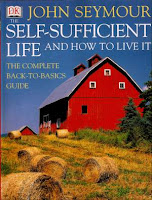 The Self Sufficient Life and How to Live It by John Seymour. Recommended.
Doomer Alert: I have been trying to expand my knowledge of simpler times, in the off chance that peak oil (or any one of the other ulcer-forming scenarios) really does end civilization as we know it. So far this has consisted of checking out a variety of library books on the following topics: gardening, alternative energy sources, food preservation, organic agriculture/horticulture, survival, and overall self sufficiency. Many of these books I found to be of little-to-no use, so I have not been posting reviews. I do believe this book has merit, dear reader, so I thought I would take the time to share it with you.
I will preface this review with the following comments. I doubt that there is any complete self-sufficiency guide. This book comes pretty close to the mark. It spans a wide range of topics and each topic has a good amount of depth. I tend to think of this book as an overarching primer, that would give you a starting point to begin research in each specific arena. (You aren't going to become an expert/competent bee-keeper after reading one page about it) Obviously, each topic most likely has volumes written about it, so to think that one book cold completely cover all the topics that a human would need to be totally self-sufficient is asking a little much. With that said, I will outline the book's many topics:
- Overview of Self-Sufficiency
- Food from the Garden
- Food from Animals
- Food from the Fields
- Food from the Wild
- Dairy Processes
- Kitchen Skills
- Brewing/Winemaking
- Energy and Waste
- Crafts and other skills
- Contacts and References
An Urban Garden
A Community Garden
A One-Acre Farm
A Five-Acre Farm
I also enjoyed the gardening section, which delineated the development of seedlings, planting, and harvesting of many vegetable and fruit varieties. Also of note was the description of small scale farming of grains and root crops in fields, as well as suggestions for crop rotation.
The book shows us there are many things to learn if one was to consider being completely self-sufficient. The main thing I learned was that: I don't want to have to become completely self-sufficient. For some, it may conjure up romantic images of Little House on the Prairie, but honestly, it would stink. I know, people have been doing it for thousands of years; heck, large portions of our population lived this way less than 2 generations ago. I give my respect to those hardy souls, but I would prefer not to be tested in such a way.
Fortunately, I do not think that it is guaranteed (or even really likely) that my family or I will ever be forced to become entirely self-sufficient. This does not mean it is not wise to begin to learn several sets of these skills. If a long term recession/depression hits the US/world, many of these skills could make a huge difference in overall quality of life. So, I will continue to research these topics, and share them with the few folks that happen to stumble upon these words.
Subscribe to:
Posts (Atom)