Showing posts with label garden. Show all posts

Saturday, February 21, 2009

New Ag Secretary Tom Vilsack


Obama's new Agriculture secretary has already made some steps to promote local food. First, is a stricter interpretation of a labeling directive in the last farm bill. Mexico and Canada both oppose such "country of origin" labels, since meat packers can now mix US and foreign meat without notifying consumers. I fully support free trade - and have large reservations about 'Buy American' laws. This, however, only gives the consumer information. The consumer can make the choice to support the producer he wishes, rather than being left in the dark.

The labeling requirements, which would apply to fresh meats and some perishable fruits and vegetables, have long been debated in Congress. While the meat industry and retailers responsible for the labels have protested the changes — saying they are burdensome and could lead to higher prices — consumer groups and northern state ranchers who compete with the Canadian beef industry favor them.
Another interesting step is to create community garden projects at all USDA facilities worldwide.
During today's ceremony, Secretary Vilsack announced the goal of creating a community garden at each USDA facility worldwide. The USDA community garden project will include a wide variety of garden activities including Embassy window boxes, tree planting, and field office plots. The gardens will be designed to promote "going green" concepts, including landscaping and building design to retain water and reduce runoff; roof gardens for energy efficiency; utilizing native plantings and using sound conservation practices.
...
The garden will showcase conservation practices that all Americans can implement in their own backyards and green spaces. As a component of the garden, pollinator-friendly plantings will not only provide important habitat for bees and butterflies, but can serve as an educational opportunity to help people understand the vital role pollinators play in our food, forage and all agriculture. The garden plot is adjacent to the site of the USDA Farmer's Market.

Read More...

Saturday, January 31, 2009

How to Dry Foods


How to Dry Foods. Deanna DeLong. Recommended.

A food dehydrator was on my Christmas list this year, and as luck would have it, one appeared under the tree. A fairly comprehensive instruction manual accompanied the dehydrator, but I thought I would look for more guidance. This book seems to be a complete guide for home food drying. All major foods are covered: fruits, vegetables, meats, herbs, spices, nuts, and seeds. Not only does the text list foods that are great for drying, but it cautions against others that are only marginal. This will save countless hours of fruitless trial and error.

The recipe section has many jerky marinade formulations and fruit leather mixtures. Also included are many recipes that use the dried products, so you know what to do with all the things you have preserved.

I would highly recommend this if you are interested in food dehydration. Thus far I have made some pretty decent beef jerky and dried pineapple. Perhaps as I gain more skill I will post some of my favorite recipes.

Read More...

Sunday, September 21, 2008

The Vegetable Gardener's Bible


The Vegetable Gardener's Bible. Edward C. Smith. Highly Recommended.

I try to only share good books with my readers, and this one is no exception. It is a thick, sturdy hardcover that will be a welcome addition to any gardener's library. For high yields, the author teaches a WORD System: Wide rows, Organic methods, Raised beds, Deep soil. The book is divided into three overarching sections:

Part 1: From Seed to Harvest

The first section is the most detailed. This is where the author lays out the basics for his WORD method. Along with several other sources, this is was the main inspiration for building my framed raised beds. There are several great chapters in this section that describe planning and executing your garden.

Part 2: The Healthy Garden

This section covers the basics of soil, composting and organic pest control. While not as detailed as the books to each of these topics, it gives a good overview.

Part 3: Vegetables & Herbs, A-Z

This section features the obligatory plant profiles that most garden books seem to provide. It truly does have quite an extensive selection of edible plants, with over 100 pages dedicated to this chapter. Each profile has a wide range of data, from planting and harvesting information to the best varieties to use.

All in all, this book is a great resource for both beginning and seasoned gardeners.

Read More...

Sunday, September 14, 2008

The Self-Sufficiency Handbook - and a Few "Deep Thoughts"


The Self-Sufficiency Handbook: A Complete Guide to Greener Living. Alan and Gill Bridgewater.

As I have said many times before, I truly doubt the existence of a complete self-sufficiency book. While this text boldly proclaims as such in the title, I have not yet been proved wrong. This handbook has a lot of great information, but it is rather thin...and would serve best as only a light introduction to self-sufficiency. It would not be undesirable in a library, but hardly necessary. For those so inclined, I have two superior recommendations here and here. I would not have even written a review, however the opening paragraph struck me, and I want to share it - and my thoughts - with you.

When Gill and I graduated from art school in the 1960s, the whole place was buzzing with a new kind of freedom. Somehow we all felt that we could do it - meaning life - better than previous generations. I remember one evening sitting in a college common room listening to two young, hippy, American lecturers animatedly talking about how very soon we would all be forced by the failure of oil supplies to return to some sort of Amish type self-sufficiency - log cabins maybe, horses rather than cars, communes where groups of like-minded people pulled together to create a better society - and it was very exciting.

As they saw it, and as whole swathes of people saw it, our consumer society was living off the fast shrinking capital resources of the earth. Their thinking was that ever since the start of the industrial revolution we had been taking and dumping: taking the coal and dumping the waste, taking the oil and dumping pollution, taking the goodness from the soil and leaving it barren, cutting down trees, and so on.
The authors continue on, explaining how this shaped their desire to live in a self-sufficient and less ecologically impacting manner. They then spent the next 30-40 years of their lives scrounging around, trying to make ends meet. As I also have stated before, the romanticism of self-sufficiency does not fool me. I don't find it that exciting and I do not think it would be an ideal way to live. Anyway, the introduction instantly struck me in two ways:

1. Maybe there really is no urgent problem
2. Crying wolf...and its ramifications

First off, my gut reaction was, "Man, people really have been screaming, 'The end is nigh!' for a long time." Maybe all the people screaming about it now really are full of it, too. Maybe peak oil and global warming are not that big of a deal...and if they are, maybe they are decades or centuries away from affecting us.

Then, that little seed of doubt creeps back in. Perhaps the hippies back then were right all along, just off in the time frame. My mind continues to file through all the evidence that I have complied during the short amount of time that I have concerned myself with such matters. Yes, peak oil must be real, and the while the time frame is up for debate, the one that I have settled on is definitely within my lifetime, or at least the next generation's.

Global warming is a challenge that I have yet to tackle, and I am not a climatologist. I will have to default to the consensus of current scientific opinion and Al Gore. I fear that it is real, it is man-made, and due to the Tragedy of the Commons, it may be inevitable. The time frame on climate change is very much up for debate as well, due to its extremely complex and variable nature; but if you watch the Discovery Channel, you know it is coming pretty soon - and will not be pretty.

So, the long standing cries from environmentalist and other scientists may have been 'spot on' the entire time. Perhaps it was the relevance time between the earth's geologic clock and the 24-hr news cycle that has caused the disconnect. And ultimately, the fable of the "Boy Who Cried Wolf" seems rather fitting; and rather disturbing, considering the end result.

These are the two extremes I continue to wrestle with. And as I have argued in the past, few things in life are black and white. For my own benefit, (and hopefully yours) I will continue to attempt to search through the gray area. Depending on the source, you can get pretty good (and bad) arguments from both sides. There are folks with full time jobs that research these issues, as well as those that literally devote their entire lives to finding the truth. How can the layman be expected to sort through it all? I suppose all we can do is just continue to plug along; hoping for the best and preparing for some version of the worst.

Read More...

Saturday, September 13, 2008

It's Not Easy Being Green


My beautiful, loving wife happened upon an episode of an interesting show called "It's Not Easy Being Green", on the Sundance Channel. According to their website, the first season shares a family's quest to become self-sufficient and more environmentally aware. In the second season, they help others with eco-friendly projects.

The first episode I saw was from the new season (Episode 6, I believe), and featured a wide range of projects. One trendy couple installed a new passive solar water heater on their fixer-upper, but ran into problems due to a historic district zoning board. Another group put up a small wind turbine. The guys also built a smoker from a 55 gallon drum and smoked some cheese. I was a bit concerned about what type of chemicals were originally contained in the drum. They burned a rather large fire to decontaminate it, but I would still be leery.

The final project involved setting up a small field for pigs; complete with shelter, water and an electric fence. The pigs provided a dual purpose - obviously they can be used for meat -but they also till and fertilize the land. The former pig pen can make a great garden the following year. And it was rather humorous to see them eating sausages at the end of the show.

I found the show to be rather funny and informative, and I fully recommend searching it out. It has definitely found a place on my DVR; hopefully I can catch up on past installments. I'd be interested to hear from anyone else who is familiar with this. Are there any specific episodes I should look out for?

Read More...

Thursday, September 11, 2008

Farmland.org Blog Contest


My loyal readers may remember this post where I highlighted the American Farmland Trust. They are running a "Friends of Farmland" blog contest through the end of September, and I would love to be included in their next newsletter. So, if you don't mind, dear reader, please follow the bucolic little scene on the left toolbar or the apple in this post, and check them out. You can get the free "No Farms, No Food" bumper sticker, or a Farmers' Market tote bag for a small donation. Also, check out their listings of Farmers' Markets in your area as well as the article "7 Ways to Save Farmland".

I think they are a good cause...for anyone who enjoys eating. Thanks!


Read More...

Sunday, September 7, 2008

Eating on $100 a Week?


Here is an interesting article chronicling a family of four's attempt to eat for a week, spending only $100. With increasing energy and food costs, this may be harder than ever. I know our family has been attempting to lower our overall costs, and food is one area that is up for examination. One must balance thrift with health, however, and eating only mac and cheese and mayo sandwiches is not advised.

Some interesting facts and ideas from the article:

- A food stamp allowance for a family of four is $117
- A $100 budget gave us $1.19 a meal per person (wow)
- "Americans are obsessed with protein, but it's the one nutrient we actually get too much of"
- Planning is key: if you do not buy enough, you'll have to go back and end up spending more (impulse items)
- "The most inexpensive snacks are also some of the healthiest"

It should be noted that as Americans, we recently have spent less of food as a percentage of household income than ever in history (less than 10%). Even with recent increases due to higher energy prices; we still spend relatively little on food. Compared to the rest of the world, this number is high on absolute terms, though. A main reason for this is the large amounts of processed and convenience foods that we eat. Pound for pound, prepared and processed foods cost much more than 'real' food.

If one factors the time involved in preparation, some packaged foods may come out ahead economically, depending on your salary. This says nothing about the nutritional value, however, and the increase in quick food has a strong correlation to our expanding waistlines.

As the article notes, some fresh vegetables did not fit in the super-econo budget. (Organics are even pricier) But as it also noted, this was a budget that was under a poverty level. By substituting many name-brand, convenience, and packaged foods with whole, healthy ones, American's could cut our food budgets by large amounts and our middle sections as well.

Another idea: adding a prolific back yard garden could help your wallet and waistline, also.

A good site for further reading: food related economic data.

Read More...

Saturday, September 6, 2008

Dwarf Fruit Trees


I planted a dwarf fig and lemon tree back in June. I thought I would show some pictures of their progress. Both have grown quite a bit, but the fig tree has been especially prolific.

Read More...

Tuesday, September 2, 2008

How To: Build a Raised Bed Garden


One of the recurring themes in many of the gardening books I have reviewed is the importance of good soil. I have slowly realized that the lack of this may be causing some of the issues in my garden. The soil around my house is primarily clay and rocks. It is actually amazing anything can grow in it.

Before the arrival of some new plants this fall, I thought I would prepare a double-dug raised bed.

The raised bed garden will provide many benefits:

1. Low maintenance
2. Less compaction
3. Higher production per square foot
4. Improved drainage
5. Less water use
6. Improved pest control

This is a step-by-step account of the process.


Step 1: Build a frame and position in place. This frame is constructed from three 8 foot 2"x8" planks, with some 2"x4" sections in the corners for bracing. The bed will be approximately 4'x8'. Mark around the frame to highlight the outline. You can use flour or just scratch with a shovel.


Step 2: Remove sod. This can be saved, turned over, or composted. Since I am planning on planting soon, I opted to add it to the compost pile.


Step 3: Now for the double-dig. First remove a trench of soil and set aside on a tarp or wheel barrow. Then till the bottom of the trench with a garden fork or other handy tool.


Step 4: Repeat this process. This time take the soil from the new trench and lay it in the old trench. Attempt to keep the soil "right side up", as generally the soil farther down is of lesser quality.


Step 5: Continue this process for the entire area. Use the soil that you removed from the first trench to fill in the last one.


Here are some of the rocks that were removed. It really was crappy soil.


Step 6: Add organic material. This is a wheelbarrow of leaf and grass compost.


Step 7: Use the same tilling tool to finish breaking up the soil and incorporating compost, topsoil, manure, sand, vermiculite, and/or other amendments, depending on what your soil requires.


Step 8: Reposition the frame and continue to add soil amendments until the bed is a few inches from the top. The raised bed is now ready to plant.


Read More...

Friday, August 29, 2008

The New Kitchen Garden


The New Kitchen Garden. Anna Pavord. Recommended.

Another book review for your perusal...

This book is a fairly good reference to start or expand your garden. Its main focus is a small garden for the average household, surprisingly enough known as a "kitchen garden".

The first chapter highlights various garden styles and features. Being from the DK Press, the book has a definite British feel to it. (I have enjoyed all the books from this publisher, and will select books from them on name alone.) For those unfamiliar with the term "kitchen garden" (like me), it is a rather formal style, normally walled in, with a large variety of food plants for consumption by the household.

After the description and layout of the traditional kitchen garden, many other styles and features are shown; formal fruit garden, hedges, salad & herb garden, cottage garden, patio & balcony gardens, and a formal herb garden. These styles are each given rather extensive treatment.

The second section gives a biography of nearly every type of vegetable and fruit that one would care to plant. Each specimen is given at least two full pages, listing vital stats; large photographs, a basic history, how to optimally cultivate, and specific recommended cultivars. Many entries also have recipes as a suggestion on how to use your harvest.

The final section is all about improving your gardening skills - planning & cultivating techniques. Plot design, soil preparation, crop rotation, starting seeds, and a plethora of growing methods are covered, just to name a few. There are many good tips to be found here.

I recommend this book for any gardener's library. I have already used some of the tips for strawberries in my own patch. As my garden expands, this will be a good reference.

Read More...

Saturday, August 23, 2008

Basic Country Skills


Storey's Basic Country Skills. A Practical Guide to Self-Reliance. Highly Recommended.

As I noted in this post, self-sufficiency may become increasingly necessary in the future. In that same post, I reviewed a very good primer on self-sufficiency. This one, dear reader, gives it a run for its money.

The book is divided into four simple categories: home, garden/orchard, cooking/preserving, and your barn/stable/fields. Each section has a wide range of skills that it describes in fairly extensive detail. Since one person cannot possibly be an expert on every single discipline that is examined, the author has compiled excerpts from other books and articles from authors who are experts.

I feel that this gives the book even more utility, since if you find a section interesting, you can head down to your local library and have a name of a useful resource at your fingertips. There are literally hundreds of sources for this book. I noticed that several sections were drawn from books that I have already featured, Dirt Cheap Gardening, for instance.

Home

This section, as you may have surmised, deals with your homestead. First selecting a good site, and then improving and maintaining it. There are many home improvement skills covered (which probably should only be used as a starting point). It also covers water, plumbing, electricity, and other utilities.

Garden & Orchard

This is the most extensive section of the book. There are tips to improve your ability to grow just about any type of plant; from vegetables to flowers to your lawn. Both pests and beneficial animals are highlighted in separate sections. Greenhouses, sheds and other structures are illustrated; and rock and water gardens are given a small treatment, as well.

Cooking & Preserving

This section has many recipes and techniques to preserve food and create new taste sensations. Even cheese and yogurt recipes are included (which I most likely will not be attempting). There are sections for butchering and preserving meat, but once again, I will most likely not be trying. It seems like butchering animals might be something you learn from somewhere other than a book. What could possibly go wrong?

Barn, Stables and Fields

Care of farm animals of all types are highlighted here; such as cows, swine, goats and rabbits. Even country pets - the outdoor dog and cat - are examined. There is also an extensive section on small scale farming which I found to be quite interesting. High value, labor intensive crops are suggested; pumpkins, bees, Christmas trees and many other cash crops are covered in detail. There are also chapters for farm structures, tools and implements.

As I have said before, there is no complete self-sufficiency guide. However, this book has a very wide range of subjects and is the best overall self-sufficiency book I have reviewed to date. It has applications for nearly anyone; from an apartment dwelling urbanite, to the most rugged independent homesteader. I recommend it for anyone's home library.

Read More...

Saturday, August 9, 2008

Organic Pest & Disease Control


Organic Pest & Disease Control. Taylor's Weekend Gardening Guides. Highly Recommended.

I picked this book up to research the control of tent caterpillars. We had quite an outbreak this year, and I wanted to get a leg up on them. I have a feeling that they will be gunning for my new plum trees. Anyway, on to the review.

The book is divided into five main chapters. The first is Creating a Healthy Garden, and the next four cover each of the following nuisances: pests, diseases, weeds, and animal pests.

As I noted, the first chapter examines the importance of creating your garden from the beginning to be healthy. There will be less pests and weeds to repel if your garden is strong from the start. This seems to be a common theme in nearly all of the books I have read thus far. Some tips (these may sound familiar): good soil, choose the right plants, diversify, and recordkeeping.

Now the real meat of the book..how to identify and eliminate pests. The glossy pages exhibit large pictures and illustrations that seem to come to life. There are full color renderings as well as smaller, life-sized examples. Besides the pests themselves, the damage that they might leave behind is shown as well for forensic comparison. Along with each set of illustrations is text describing the pest, its damage, and organic ways to control it.

I would highly recommend this book for the novice organic gardener. For those with more experience, it may not be as useful, but there are many pests, diseases and weeds featured. It may be a lifesaver if your local garden store does not have the answers you need.

Oh, and for the tent caterpillars? Actually, I had originally thought they were bagworms, but this book straightened me out. So, you learn something new everyday. The book recommends manual removal, burning the nests and sprays of BTK (Bacillus thuringiensis var. kurstaki). I have also heard that pheromone traps in the spring will capture the moths before they can lay eggs.

Read More...

Sunday, August 3, 2008

Dirt Cheap Gardening

Dirt Cheap Gardening. Rhonda Massingham Hart. Recommended.

From the title alone, I knew this book was right up my alley. The combination of gardening and frugality is a winning combination in my view. Like any hobby, gardening can become quite a money sink. Despite the best of intentions, an activity that is begun to help the family finances may end up taking more resources than it produces. This book will help you avoid such pitfalls and perhaps make the experience both more productive and enjoyable. While I have begun gardening again to learn new skills rather than completely sustain my family, I do not necessarily think that I will necessarily be making large amounts of money. That being said, whenever possible, I prefer to not squander resources.

The book is divided into ten chapters, each with its own set of tips for saving time and/or cash. I think it is an important point to remember that time is a precious resource as well, many times much more valuable than money.

1. The Absolutes
This chapter is the anchor of the book, describing the basics of gardening. All of the initial decisions you make will affect the results of your garden. Site selection is key, as well as correctly choosing plants for each site. Obviously, putting plants that require full sun into a shady spot will only cause you frustration and end up wasting resources. So working with what you have is an important point. If you are short on space, perhaps containers would be the most effective solution.
Soil quality (a recurring theme in most gardening books I have read) is very important. Compost is a cheap way to increase the productivity of your soil, and this book has several ideas on where and how to get other cheap soil amendments. Testing for nutrients and pH is also covered. Another key point (that I have had to relearn on several occasions) is water. Setting up a system that provides the correct amount of water (either manual or automatic) will save your plants from certain doom. There is no better way to waste a lot of time and money than to let all your plants die when you go away on vacation. My automatic irrigation system should pay for itself quite quickly.

2. Tools vs. Toys
Gardening obviously requires a certain set of tools, but there are a plethora of choices. Many of these are quite expensive and have limited utility. The author attempts to sort the wheat from the chaff. Depending on one’s unique needs, certain tools may be quite necessary, while for others they would only be an expensive toy. It is up to you decide, but this chapter will help you navigate the many choices.

3. Priceless Plants
The plants you (or your neighbors/friends/family) already own have the amazing capability to reproduce and regenerate into new, free plants. This chapter covers the techniques that make this possible. Seed recovery, cuttings, layering, and dividing/transplanting are all examined. Many of these techniques seem to require a large amount of patience and experience, so they may not be very cost effective right away, but considering the costs of plants from the nursery they can be well worth the effort. These skills are very intriguing to me, considering if/when TSHTF, they may be very necessary.

4. Winning Varieties
Picking the correct varieties of plants will save lots of trouble. Native plants are always a good idea, since they have been naturally selected to thrive. Tolerance to your particular climate; temperature, water and specific pests/diseases, will save much time and money. There are many varieties (sometimes thousands) of each type of plant, and some may fair much better than others in your particular area, so a little research can pay large dividends. Another consideration is the value of the crops the plants produce. Berries are very expensive, and thus provide a lot of value in a small area. However, even the most valuable and prolific crops are not worth the effort if you do not like them. Unless you are growing for sale, only grow fruits and vegetables that you like to eat and flowers that you find attractive.

5. Save From the Start
When planning your garden, you can save money by using seeds vice purchased transplants. Starting you own seed takes a bit of planning and expertise, so you must take that into account. I plan on attempting to start seeds for next year’s garden, as I think it will be a valuable skill to learn. If you start a small greenhouse, you can make a side business of selling extra seedlings to friends and neighbors.

6. Plant Wellness Pays
Keeping plants healthy is important to maintain your investment. Proper fertilization is key, remember that more is not always better. Over fertilizing is wasteful, and can be detrimental to the environment. Remember that compost is a cheap and easy way to provide your plants with nutrients. Pest control and crop rotation is also covered in this chapter.

7. Cheap Skills
I’ll just list the skills that the author suggests will improve your gardening: recordkeeping, mulching, raised beds, training/trellising, pruning and pinching. Nothing really earth shattering, but each will definitely save you time and money.

8. Landscape for Less
The next chapter provides some tips for lowering your landscaping bills, while still maintaining the beauty of your yard.

9. Longer Life for your Plant Dollars
Extending the growing season has many advantages, providing for much more productivity. You can harvest both earlier and later, allowing you to maximize your garden’s potential. The author suggests several techniques to achieve this such as hotcaps, row covers, and inexpensive homemade cold frames.

10. Reap Bountiful Harvests
Once you have maximized your output, you must not let it go to waste. If you put all that time and effort into the garden, allowing the vegetables to rot on the vine seems to be very counterproductive. The book provides tips on determination of when to harvest many varieties of plants. Also, if you are blessed with a bumper crop, allowing it to rot in your fridge or countertop is not ideal either. The usual suspects of preservation techniques are covered, as well as giving your harvest away as gifts. For more information on this topic, I recommend Ball’s Blue Book of Food Preservation.

Many of the tips and ideas in this book are common sense or are found in many other gardening texts. There are some unique aspects to it, however, and it provides the information in a concise and easy to read format. I would recommend it for any gardener’s library. You’ll notice in my Amazon widget on the left hand portion of the page that it is a very inexpensive book, so you really don’t have much to lose. I think it will pay for itself in no time at all.

Read More...

Tuesday, July 29, 2008

Organic Farming


Organic Farming: Everything You Need to Know. Peter V. Fossel. Recommended.

For anyone who has dreamed of quiting one's day job and retiring to an idyllic life in the country, perhaps the thought of starting an organic produce farm would be the way to sustain you and yours. This book provides a basic background for those contemplating such a move.

The first chapter examines the benefits of organic farming; both to the environment and consumer. The next chapter highlights the author's own experiences in starting his family's farm, as well as tips for selecting and setting up your own.

The majority of the book is dedicated to the lifeblood of your new farm: building the soil. Basic soil chemistry, green manure, compost and crop rotation all get fairly extensive coverage. Healthy, robust soil will not only provide good yields, but helps prevent disease and pests. Depending on the state of the soil on your farm, this process may take years of hard work. It is best to purchase the best land you can afford.

Next is a large section on greenhouses and hoophouses. Extending the growing season is very important for both self sufficiency and to maximize profitability. There are two chapters for pest control, for both weeds and insects.

Tractors and other implements are examined; depending on the size of the farm your tractor can be small or perhaps reduced to only a rototiller. Since profit margins will likely be rather thin, reducing overhead is key. Machinery is very capital intensive.

The next two chapters focus on what I consider to be very important concepts: becoming organically certified and marketing your wares. If you are going to have an organic farm, you must find a niche market for your goods. Since you will inevitably have higher costs per unit, you must find willing buyers at those higher costs to remain solvent. This will involve differentiating your organic products from conventional ones, searching out people who appreciate the difference and educating those who may not be aware of the benefits. This can be accomplished through farmer's markets, roadside stands, and Community Supported Agriculture (CSA).

The final chapters highlight the wide variety of items you can grow on your new farm; fruits, vegetables, flowers and livestock. You may wish to have a wide variety or specialize in certain areas. Each approach has its own advantages and drawbacks.

While there would no doubt be many tangible benefits to pursuing this endeavor, I do not have any misconceptions about the difficulties that such a lifestyle change would bring. This book touches on them, but I don't believe it gives them due coverage. Such a change is probably not something that you would jump into, but rather slowly transition into after much research and practical experience.

This is the path the author recommends; starting small, gaining outside experience on a farm and not quitting your day job too quickly. I felt this should be emphasized a bit more, but I suppose there are few people foolhardy enough to read one book and jump in head first.

Pros: Good beginning overview of starting an organic farm. Easy to read, in an inviting style.

Cons: Several photos are blurry and amateurish. I doubt any book could include everything you need to know about farming, organic or otherwise; let alone one this thin (abt. 150 pgs.).

Read More...

Tuesday, July 22, 2008

Square Foot Gardening


Square Foot Gardening. Mel Bartholomew. Recommended.

This book claims to be a revolutionary way to garden...a 'new way to garden in less space with less work'. It arose from the author's realization that many gardeners were extremely enthusiastic in the spring, but lost interest as the year went on.

The basic premise is to only grow what you need, and what you actually have the time and energy to tend. Don't overextend yourself so you are able to keep up with it throughout the entire season. Setting a sustainable size for your garden is key.

The book covers all aspects of small scale gardening. From planting to harvesting and everything in between, it provides very clear tips and instructions.

I plan on using some of the techniques highlighted in this book for my garden next year. I will provide an update on how well they work at that time. Overall, the text seems well researched and is easy to digest. It seems perfect for small scale gardens, especially urban plots.

Read More...

Monday, July 7, 2008

The Other 'Black Gold'


Compost. Claire Foster. Recommended.

As I recently mentioned in the Self-Sufficient Life post, there are many topics and skills that may be beneficial to learn, and most are complex enough to warrant their own book (maybe several) and perhaps a lot of trial and error to become proficient. This topic is fairly straight forward, yet has some nuances that I discovered in this book.

This particular book is a great little primer that pretty much tells you everything you need to know about creating your own compost. First, let's review some of the benefits:

  1. Recycles organic waste
  2. Reduces landfill pressure
  3. Organically increases soil productivity
  4. Lessens need for chemical fertilizers
  5. Nutrient dense
  6. Saves money

If done correctly, the few drawbacks (odor, unsightliness, animals) can be pretty much eliminated. This book will help you to do just that.

After covering the basics, the author delves into soil science for two chapters. Physical and chemical composition of soil is covered in quick, yet informative prose. The next chapter covers exactly what ingredients you should and should not use in your compost concoction. Compost bin and container design is then examined in good detail, giving pros and cons for many types of applications and situations. Finally, the author outlines the prevailing methods for combining your ingredients and container, as well as maintenance of your pile. Worm composters and green manure are also covered in slight detail.

This is a great reference for composting. It is short (abt 100 pgs) and to the point, but holds many good ideas and tips that will increase the productivity of your composting experience. The moral of the story: there is no right or wrong way to compost, and it will take care of itself in most cases. If you wish to speed up and maximize the process, this book will help you.

I have had a simple compost pile for several years now. This year I upgraded to a commercial plastic bin. It certainly allows for a larger amount of material to be processed, mostly due to the increased heat and improved geometry. By the end of the year, I should have quite a large amount to improve my soil.

Read More...

Saturday, July 5, 2008

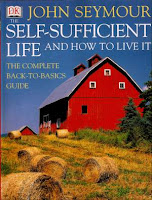
The Self-Sufficient Life

The Self Sufficient Life and How to Live It by John Seymour. Recommended.

Doomer Alert: I have been trying to expand my knowledge of simpler times, in the off chance that peak oil (or any one of the other ulcer-forming scenarios) really does end civilization as we know it. So far this has consisted of checking out a variety of library books on the following topics: gardening, alternative energy sources, food preservation, organic agriculture/horticulture, survival, and overall self sufficiency. Many of these books I found to be of little-to-no use, so I have not been posting reviews. I do believe this book has merit, dear reader, so I thought I would take the time to share it with you.

I will preface this review with the following comments. I doubt that there is any complete self-sufficiency guide. This book comes pretty close to the mark. It spans a wide range of topics and each topic has a good amount of depth. I tend to think of this book as an overarching primer, that would give you a starting point to begin research in each specific arena. (You aren't going to become an expert/competent bee-keeper after reading one page about it) Obviously, each topic most likely has volumes written about it, so to think that one book cold completely cover all the topics that a human would need to be totally self-sufficient is asking a little much. With that said, I will outline the book's many topics:

  1. Overview of Self-Sufficiency
  2. Food from the Garden
  3. Food from Animals
  4. Food from the Fields
  5. Food from the Wild
  6. Dairy Processes
  7. Kitchen Skills
  8. Brewing/Winemaking
  9. Energy and Waste
  10. Crafts and other skills
  11. Contacts and References
The book is very rich in detailed illustrations (DK Press), but no photographs. The author is British, which 'colours' the narrative a bit, but not so much as to detract from the utility of the work. I especially enjoyed the section where he describes how he would set up homesteads of various sizes. It provides an excellent overview of how one would go about starting:

An Urban Garden
A Community Garden
A One-Acre Farm
A Five-Acre Farm

I also enjoyed the gardening section, which delineated the development of seedlings, planting, and harvesting of many vegetable and fruit varieties. Also of note was the description of small scale farming of grains and root crops in fields, as well as suggestions for crop rotation.

The book shows us there are many things to learn if one was to consider being completely self-sufficient. The main thing I learned was that: I don't want to have to become completely self-sufficient. For some, it may conjure up romantic images of Little House on the Prairie, but honestly, it would stink. I know, people have been doing it for thousands of years; heck, large portions of our population lived this way less than 2 generations ago. I give my respect to those hardy souls, but I would prefer not to be tested in such a way.

Fortunately, I do not think that it is guaranteed (or even really likely) that my family or I will ever be forced to become entirely self-sufficient. This does not mean it is not wise to begin to learn several sets of these skills. If a long term recession/depression hits the US/world, many of these skills could make a huge difference in overall quality of life. So, I will continue to research these topics, and share them with the few folks that happen to stumble upon these words.

Read More...

Thursday, July 3, 2008

Give 'Em the Boot


My garden is a little behind due to the area's less than optimal planting season. None the less, I'm excited to see how the tomatoes do in their respective pots. I've had little success growing tomatoes in these conditions the past two years; usually ending their lives with small fruit and blossom end rot.

I have several varieties of basil and peppers.

THE BOOT was purchased at Home Depot. It's about 2-3 feet tall and contains a variety of campanula. I am excited to see how the plant thrives in THE BOOT. THE BOOT makes for an interesting conversation piece. Most people think I am squirrely.

Read More...

Monday, June 30, 2008

Hanging Gardens - 6/30/08


I haven't posted an update on the hanging planters in a while...so here we go. Last time I mentioned the extreme heat was causing quite a bit of stress to the plants. Strangely, this was more prominent in one bag versus the other. With some closer inspection and expert consultation, I realized that water was not fully penetrating the entire root mass, leading to the stunted growth and wilted leaves. After soaking the entire soil/root mass with a sufficient amount of water, the plants began to almost immediately improve.


On the larger of the two plum trees I purchased this year, I was surprised to find three plums that had survived the trip from the nursery and were maturing into edible fruit. About a day before ripening, one fell causality to either a bird or squirrel. After securing the tree with proper netting, the remaining plums were allowed to fully ripen and promptly devoured by their proper owners. They were quite delicious. I look forward to next year's harvest.

I have also installed an irrigation system with accompanying timer to automate the watering process. This should alleviate future instances of unnecessary drought.


Read More...

Saturday, June 14, 2008

Hanging Gardens - 6/14/08

A gardening update...the heat has been hard on the plants in the hanging bags. It has been difficult to keep them sufficiently watered. I have a feeling the plants may be getting too much sun at their present location, as well. Nevertheless, there are several small fruits appearing; tomatoes, peppers, squash and cucumbers. The strawberries are winding down for the season. It is quite amazing how much fruit can come from a 3' diameter patch.


Read More...