
 Posts


Many visitors arrive to this blog asking "Where can I buy Evaporated Cane Juice?". One easy answer: Amazon. While Amazon has always been known for new books, many people are unaware of the extensive selection of other goods. From electronics to food, cosmetics to toys, one can find just about anything. Along the left margin of my blog, one can find my list of recommended products. I also recommend checking out their selection of used books for out of print volumes and a more economical way to build a library.
Buy Evaporated Cane Juice Crystals
Other Sugar posts:
Evaporated Cane Juice: Part I
Evaporated Cane Juice: Part II
Caramel Apples
Sugar and the Environment
Alternative Sugar Names
Showing posts with label organic. Show all posts
Showing posts with label organic. Show all posts
Friday, December 18, 2009
Where to Buy Evaporated Cane Juice

Friday, August 7, 2009
A Look at Agave Nectar

This article, from Radish Magazine, takes a critical look at a natural sweetener that has recently gained popularity - agave nectar.
For those who are not familiar with agave nectar, it is a syrupy sweetener produced from the juices of a succulent plant resembling a cactus. Numerous species of agave plants are native to Mexico and the Southwestern U.S.--one of which is used to make tequila. A mature agave plant may be up to 8 feet tall with leaves spreading out to a diameter of 12 feet!
The agave nectar is sold in many health food stores (in light, amber, dark and raw varieties) for general sweetening purposes and also incorporated as a sweetening agent in many so-called organic, raw and/or diabetic-friendly health foods. It is portrayed as an unrefined and healthful sweetener, but the truth is a much more complex story.
...
The chemical and genetically-modified enzymatic processes used to manufacture the juices into agave nectar end up giving it a profile of 70 percent or more as fructose, compared to only 55 percent fructose found in HFCS. (Raw honey contains only about 38 percent fructose.) Concentrated levels of fructose in the diet may lead to mineral depletion, inflammation of the liver, hardening of the arteries, insulin resistance, high blood pressure, cardiovascular disease and obesity.
While it is true that high levels of dietary fructose will not necessarily cause spikes in blood glucose, agave nectar certainly still falls short of being a healthful alternative. It is for this reason that noted low-carb advocate, Dr. Michael Eades, M.D., has said of agave nectar: "Avoid it like death."
A less-than-ideal sugar profile may be offset somewhat by the presence of abundant minerals, which agave nectar reportedly has, including iron, calcium, potassium and magnesium. However, it is more correct to say that the juices of the agave plant contain an abundance of such minerals (as well as valuable amino acids) rather than the resultant agave nectar. While "miel de agave" retains these factors, modern processing removes many of them in order to make the taste of the agave nectar lighter and more palatable.
Other Sugar posts:
Evaporated Cane Juice: Part I
Evaporated Cane Juice: Part II
Caramel Apples
Sugar and the Environment
Alternative Sugar Names
Wednesday, November 12, 2008
FARM!
FARM! from Anthony-Masterson on Vimeo.
Here's a short documentary about young, sustainable farmers in Georgia.
Thursday, October 30, 2008
Farmer in Chief
For your sun-food agenda to succeed, it will have to do a lot more than alter what happens on the farm. The government could help seed a thousand new polyculture farmers in every county in Iowa, but they would promptly fail if the grain elevator remained the only buyer in town and corn and beans were the only crops it would take. Resolarizing the food system means building the infrastructure for a regional food economy — one that can support diversified farming and, by shortening the food chain, reduce the amount of fossil fuel in the American diet. 
Here is the counterpoint to yesterday's post, Nutrients for Life. "Farmer in Chief" is an open letter to our next President, written by Michael Pollan, the author of In Defense of Food. He outlines his vision for modifying American agricultural policy to positively influence three of our most pressing issues. No doubt you have heard the presidential candidates debate over how to solve our dependence on foreign energy, our health care system and the specter of global climate change. Since agriculture is such a cornerstone of our society, the author asserts that changes could provide positive results in all three of these issues.Whenever farmers clear land for crops and till the soil, large quantities of carbon are released into the air. But the 20th-century industrialization of agriculture has increased the amount of greenhouse gases emitted by the food system by an order of magnitude; chemical fertilizers (made from natural gas), pesticides (made from petroleum), farm machinery, modern food processing and packaging and transportation have together transformed a system that in 1940 produced 2.3 calories of food energy for every calorie of fossil-fuel energy it used into one that now takes 10 calories of fossil-fuel energy to produce a single calorie of modern supermarket food. Put another way, when we eat from the industrial-food system, we are eating oil and spewing greenhouse gases. This state of affairs appears all the more absurd when you recall that every calorie we eat is ultimately the product of photosynthesis — a process based on making food energy from sunshine. There is hope and possibility in that simple fact.
The author outlines his ideas for improvement, which all involve major shifts in agriculture policy. I've included excerpts here, but please read the entire article.
Step 1, Resolarizing the American Farm:What happens in the field influences every other link of the food chain on up to our meals — if we grow monocultures of corn and soy, we will find the products of processed corn and soy on our plates. Fortunately for your initiative, the federal government has enormous leverage in determining exactly what happens on the 830 million acres of American crop and pasture land.
Step 2, Regionalizing the Food System:
Your challenge is to take control of this vast federal machinery and use it to drive a transition to a new solar-food economy, starting on the farm. Right now, the government actively discourages the farmers it subsidizes from growing healthful, fresh food: farmers receiving crop subsidies are prohibited from growing “specialty crops” — farm-bill speak for fruits and vegetables. (This rule was the price exacted by California and Florida produce growers in exchange for going along with subsidies for commodity crops.) Commodity farmers should instead be encouraged to grow as many different crops — including animals — as possible. Why? Because the greater the diversity of crops on a farm, the less the need for both fertilizers and pesticides.
It will be argued that sun-food agriculture will generally yield less food than fossil-fuel agriculture. This is debatable. The key question you must be prepared to answer is simply this: Can the sort of sustainable agriculture you’re proposing feed the world?
There are a couple of ways to answer this question. The simplest and most honest answer is that we don’t know, because we haven’t tried. But in the same way we now need to learn how to run an industrial economy without cheap fossil fuel, we have no choice but to find out whether sustainable agriculture can produce enough food.
The second point to bear in mind is that yield isn’t everything — and growing high-yield commodities is not quite the same thing as growing food. Much of what we’re growing today is not directly eaten as food but processed into low-quality calories of fat and sugar. As the world epidemic of diet-related chronic disease has demonstrated, the sheer quantity of calories that a food system produces improves health only up to a point, but after that, quality and diversity are probably more important. We can expect that a food system that produces somewhat less food but of a higher quality will produce healthier populations.
Step 3, Rebuilding America's Food Culture:In the end, shifting the American diet from a foundation of imported fossil fuel to local sunshine will require changes in our daily lives, which by now are deeply implicated in the economy and culture of fast, cheap and easy food. Making available more healthful and more sustainable food does not guarantee it will be eaten, much less appreciated or enjoyed. We need to use all the tools at our disposal — not just federal policy and public education but the president’s bully pulpit and the example of the first family’s own dinner table — to promote a new culture of food that can undergird your sun-food agenda.
Pollan is a good author, and makes his views seem quite easy to implement. I can see some major hurdles to these policy changes, however, and some minor quibbles with several of his points.
Changing the food culture must begin with our children, and it must begin in the schools. Nearly a half-century ago, President Kennedy announced a national initiative to improve the physical fitness of American children. He did it by elevating the importance of physical education, pressing states to make it a requirement in public schools. We need to bring the same commitment to “edible education” — in Alice Waters’s phrase — by making lunch, in all its dimensions, a mandatory part of the curriculum. On the premise that eating well is a critically important life skill, we need to teach all primary-school students the basics of growing and cooking food and then enjoying it at shared meals.
The president should throw his support behind a new Victory Garden movement, this one seeking “victory” over three critical challenges we face today: high food prices, poor diets and a sedentary population. Eating from this, the shortest food chain of all, offers anyone with a patch of land a way to reduce their fossil-fuel consumption and help fight climate change. (We should offer grants to cities to build allotment gardens for people without access to land.) Just as important, Victory Gardens offer a way to enlist Americans, in body as well as mind, in the work of feeding themselves and changing the food system — something more ennobling, surely, than merely asking them to shop a little differently.
I don’t need to tell you that ripping out even a section of the White House lawn will be controversial: Americans love their lawns, and the South Lawn is one of the most beautiful in the country. But imagine all the energy, water and petrochemicals it takes to make it that way. (Even for the purposes of this memo, the White House would not disclose its lawn-care regimen.) Yet as deeply as Americans feel about their lawns, the agrarian ideal runs deeper still, and making this particular plot of American land productive, especially if the First Family gets out there and pulls weeds now and again, will provide an image even more stirring than that of a pretty lawn: the image of stewardship of the land, of self-reliance and of making the most of local sunlight to feed one’s family and community. The fact that surplus produce from the South Lawn Victory Garden (and there will be literally tons of it) will be offered to regional food banks will make its own eloquent statement.
1. Economic troubles.
As money gets tight, food price increases will be hard to politically justify. It does not matter that food prices are at historic lows...perhaps the cheapest of any civilization, ever. People already started bitching about food increases this past year...it is an American right, cheap food and fuel.
Large scale unemployment, however, may provide a large base of manpower for more labor-intensive agriculture. Perhaps many people get a first-hand look at what jobs migrant workers are currently "stealing" from the American public.
2. Farmers as "drivers".Farming without fossil fuels — performing complex rotations of plants and animals and managing pests without petrochemicals — is labor intensive and takes more skill than merely “driving and spraying,” which is how corn-belt farmers describe what they do for a living.
I find this to be quite patronizing. I know no farmer who would honestly describe himself in such a way. I suspect the author did not pick up on the humility and self-deprication of his subject. Organic farming is more labor intensive, that point is well recieved. Adding more human capital to the agricultural system will be a challenge of its own. But to say it takes no skill to run a modern farm is ludicrous. It takes a decidedly different set of skills, and new organic skills will need to be learned and disemminated. As the average age of the American farmer increases, this will be more and more difficult. It will take a youth movement, and few people (young or old) today are interested in the arduous and capricious way of life found in agriculture.
3. Energy Calorie per Food Calorie....a system that in 1940 produced 2.3 calories of food energy for every calorie of fossil-fuel energy it used into one that now takes 10 calories of fossil-fuel energy to produce a single calorie of modern supermarket food...
Much of this certainly can be explained by the long distances that food now travels. The other factor is that millions of farmers have left the business and there are simply much less human calories at work. This has been supplanted by fossil fuels.
4. Supermarket for the World
Some opponents of organic agriculture point to the fact that we might not be able to maintain the huge outputs of food that we once did. I tend to subscribe to the notion that it is not our duty to feed the entire world. Many of his suggested policies may lower the amount of available food. For years, our subsidized grain has driven world prices down, not allowing indigenous people to economically farm. Now will be their chance. I also feel grain prices are a great geopolitical lever that we control. China has become quite reliant on us, importing more and more in the last few years. We must not neglect this as a bargaining tool.
5. A Matter of Taste
The rise of the industrial food system was helped along by policies, but it rests on the simple fact that all people like to eat cheap, tasty, sweet, fatty and salty foods. This small, sticky fact will not go away, it is hard-wired in our DNA. It will be very hard to convince people to pay more for food that they do not prefer. However, the author brings up the pertinent point - this cheap, unhealthy food is being subsidized. Not only by farm subsidies for grain, but by our increasing health insurance premiums. If we remove these incentives and force people to pay the true cost, the decision calculus may begin to swing in a more healthy direction. The huge amount of political capital and will to do this may be simply unattainable, however.
All in all, there are some very interesting ideas contained in his letter. I believe that less reliance on huge agribusiness and heavier reliance on local small agriculture has many benefits. Whether we can make such a transition remains to be seen. The individual consumer now has more of a choice than ever; buy fresh, organic, local food and provide a market for these products. Don't eat fast food and prepackaged meals. Grow a garden. Small steps by large amounts of people can have huge impacts.
Read: Farmer in Chief
Sunday, September 14, 2008
The Self-Sufficiency Handbook - and a Few "Deep Thoughts"
 The Self-Sufficiency Handbook: A Complete Guide to Greener Living. Alan and Gill Bridgewater.
As I have said many times before, I truly doubt the existence of a complete self-sufficiency book. While this text boldly proclaims as such in the title, I have not yet been proved wrong. This handbook has a lot of great information, but it is rather thin...and would serve best as only a light introduction to self-sufficiency. It would not be undesirable in a library, but hardly necessary. For those so inclined, I have two superior recommendations here and here. I would not have even written a review, however the opening paragraph struck me, and I want to share it - and my thoughts - with you.When Gill and I graduated from art school in the 1960s, the whole place was buzzing with a new kind of freedom. Somehow we all felt that we could do it - meaning life - better than previous generations. I remember one evening sitting in a college common room listening to two young, hippy, American lecturers animatedly talking about how very soon we would all be forced by the failure of oil supplies to return to some sort of Amish type self-sufficiency - log cabins maybe, horses rather than cars, communes where groups of like-minded people pulled together to create a better society - and it was very exciting.
The authors continue on, explaining how this shaped their desire to live in a self-sufficient and less ecologically impacting manner. They then spent the next 30-40 years of their lives scrounging around, trying to make ends meet. As I also have stated before, the romanticism of self-sufficiency does not fool me. I don't find it that exciting and I do not think it would be an ideal way to live. Anyway, the introduction instantly struck me in two ways:
As they saw it, and as whole swathes of people saw it, our consumer society was living off the fast shrinking capital resources of the earth. Their thinking was that ever since the start of the industrial revolution we had been taking and dumping: taking the coal and dumping the waste, taking the oil and dumping pollution, taking the goodness from the soil and leaving it barren, cutting down trees, and so on.
1. Maybe there really is no urgent problem
2. Crying wolf...and its ramifications
First off, my gut reaction was, "Man, people really have been screaming, 'The end is nigh!' for a long time." Maybe all the people screaming about it now really are full of it, too. Maybe peak oil and global warming are not that big of a deal...and if they are, maybe they are decades or centuries away from affecting us.
Then, that little seed of doubt creeps back in. Perhaps the hippies back then were right all along, just off in the time frame. My mind continues to file through all the evidence that I have complied during the short amount of time that I have concerned myself with such matters. Yes, peak oil must be real, and the while the time frame is up for debate, the one that I have settled on is definitely within my lifetime, or at least the next generation's.
Global warming is a challenge that I have yet to tackle, and I am not a climatologist. I will have to default to the consensus of current scientific opinion and Al Gore. I fear that it is real, it is man-made, and due to the Tragedy of the Commons, it may be inevitable. The time frame on climate change is very much up for debate as well, due to its extremely complex and variable nature; but if you watch the Discovery Channel, you know it is coming pretty soon - and will not be pretty.
So, the long standing cries from environmentalist and other scientists may have been 'spot on' the entire time. Perhaps it was the relevance time between the earth's geologic clock and the 24-hr news cycle that has caused the disconnect. And ultimately, the fable of the "Boy Who Cried Wolf" seems rather fitting; and rather disturbing, considering the end result.
These are the two extremes I continue to wrestle with. And as I have argued in the past, few things in life are black and white. For my own benefit, (and hopefully yours) I will continue to attempt to search through the gray area. Depending on the source, you can get pretty good (and bad) arguments from both sides. There are folks with full time jobs that research these issues, as well as those that literally devote their entire lives to finding the truth. How can the layman be expected to sort through it all? I suppose all we can do is just continue to plug along; hoping for the best and preparing for some version of the worst.
Saturday, September 13, 2008
It's Not Easy Being Green

My beautiful, loving wife happened upon an episode of an interesting show called "It's Not Easy Being Green", on the Sundance Channel. According to their website, the first season shares a family's quest to become self-sufficient and more environmentally aware. In the second season, they help others with eco-friendly projects.
The first episode I saw was from the new season (Episode 6, I believe), and featured a wide range of projects. One trendy couple installed a new passive solar water heater on their fixer-upper, but ran into problems due to a historic district zoning board. Another group put up a small wind turbine. The guys also built a smoker from a 55 gallon drum and smoked some cheese. I was a bit concerned about what type of chemicals were originally contained in the drum. They burned a rather large fire to decontaminate it, but I would still be leery.
The final project involved setting up a small field for pigs; complete with shelter, water and an electric fence. The pigs provided a dual purpose - obviously they can be used for meat -but they also till and fertilize the land. The former pig pen can make a great garden the following year. And it was rather humorous to see them eating sausages at the end of the show.
I found the show to be rather funny and informative, and I fully recommend searching it out. It has definitely found a place on my DVR; hopefully I can catch up on past installments. I'd be interested to hear from anyone else who is familiar with this. Are there any specific episodes I should look out for?
Thursday, September 11, 2008
Farmland.org Blog Contest

My loyal readers may remember this post where I highlighted the American Farmland Trust. They are running a "Friends of Farmland" blog contest through the end of September, and I would love to be included in their next newsletter. So, if you don't mind, dear reader, please follow the bucolic little scene on the left toolbar or the apple in this post, and check them out. You can get the free "No Farms, No Food" bumper sticker, or a Farmers' Market tote bag for a small donation. Also, check out their listings of Farmers' Markets in your area as well as the article "7 Ways to Save Farmland".
I think they are a good cause...for anyone who enjoys eating. Thanks!
Tuesday, September 2, 2008
How To: Build a Raised Bed Garden
One of the recurring themes in many of the gardening books I have reviewed is the importance of good soil. I have slowly realized that the lack of this may be causing some of the issues in my garden. The soil around my house is primarily clay and rocks. It is actually amazing anything can grow in it.
Before the arrival of some new plants this fall, I thought I would prepare a double-dug raised bed.
The raised bed garden will provide many benefits:
1. Low maintenance
2. Less compaction
3. Higher production per square foot
4. Improved drainage
5. Less water use
6. Improved pest control
This is a step-by-step account of the process.
Step 1: Build a frame and position in place. This frame is constructed from three 8 foot 2"x8" planks, with some 2"x4" sections in the corners for bracing. The bed will be approximately 4'x8'. Mark around the frame to highlight the outline. You can use flour or just scratch with a shovel.
Step 2: Remove sod. This can be saved, turned over, or composted. Since I am planning on planting soon, I opted to add it to the compost pile.
Step 3: Now for the double-dig. First remove a trench of soil and set aside on a tarp or wheel barrow. Then till the bottom of the trench with a garden fork or other handy tool.
Step 4: Repeat this process. This time take the soil from the new trench and lay it in the old trench. Attempt to keep the soil "right side up", as generally the soil farther down is of lesser quality.
Step 5: Continue this process for the entire area. Use the soil that you removed from the first trench to fill in the last one.
Here are some of the rocks that were removed. It really was crappy soil.
Step 6: Add organic material. This is a wheelbarrow of leaf and grass compost.
Step 7: Use the same tilling tool to finish breaking up the soil and incorporating compost, topsoil, manure, sand, vermiculite, and/or other amendments, depending on what your soil requires.
Step 8: Reposition the frame and continue to add soil amendments until the bed is a few inches from the top. The raised bed is now ready to plant.
Friday, August 29, 2008
The New Kitchen Garden
 The New Kitchen Garden. Anna Pavord. Recommended.
Another book review for your perusal...
This book is a fairly good reference to start or expand your garden. Its main focus is a small garden for the average household, surprisingly enough known as a "kitchen garden".
The first chapter highlights various garden styles and features. Being from the DK Press, the book has a definite British feel to it. (I have enjoyed all the books from this publisher, and will select books from them on name alone.) For those unfamiliar with the term "kitchen garden" (like me), it is a rather formal style, normally walled in, with a large variety of food plants for consumption by the household.
After the description and layout of the traditional kitchen garden, many other styles and features are shown; formal fruit garden, hedges, salad & herb garden, cottage garden, patio & balcony gardens, and a formal herb garden. These styles are each given rather extensive treatment.
The second section gives a biography of nearly every type of vegetable and fruit that one would care to plant. Each specimen is given at least two full pages, listing vital stats; large photographs, a basic history, how to optimally cultivate, and specific recommended cultivars. Many entries also have recipes as a suggestion on how to use your harvest.
The final section is all about improving your gardening skills - planning & cultivating techniques. Plot design, soil preparation, crop rotation, starting seeds, and a plethora of growing methods are covered, just to name a few. There are many good tips to be found here.
I recommend this book for any gardener's library. I have already used some of the tips for strawberries in my own patch. As my garden expands, this will be a good reference.
Saturday, August 16, 2008
Evaporated Cane Juice vs. Sugar, Part II
VanDien's assessment of sweeteners is pretty rigorous. She thinks virtually every commonly used sweetener is as bad as sugar when it makes up a significant part of the diet, as it does for too many Americans. "Whether you're talking about cane sugar, honey, barley malt or Sucanat (a tradenamed product), they're all primarily simple sugars, simple carbohydrates," VanDien explains. "People should be concerned that, if they're eating 150 pounds of sugar a year and you change that to 150 pounds of barley malt, you'll have the same problems with your immune system and blood sugar levels you would have if you are eating the sugar." The second expert, with a PhD in nutrition, agrees:
As I noted in this post, I was skeptical about the differences between Evaporated Cane Juice and regular table sugar. As I found, the difference is negligible, and the price would not seem to justify the small amount of nutrients that might be found in Cane Juice. I found an article that examines the issue a bit more, this time examining the health ramifications of simple carbohydrates.
First, the author lists the plethora of alternate names that "sugar" has picked up in the health food aisle:Perhaps because it sounds like it fits in with a New Age mentality, a lot of manufacturers are using the word "crystals" in describing their sweetening agents nowadays. But sugar they are. To list just a few, there are: cane juice crystals, dehydrated cane juice crystals, unrefined cane juice crystals, raw cane crystals, washed cane juice crystals, Florida crystals (a trademarked name), unbleached evaporated sugar cane juice crystals, crystallized cane juice, and unbleached crystallized evaporated cane juice. There are also products with such names as organic dehydrated cane juice, unbleached sugar cane, evaporated cane juice, and evaporated cane juice sugar.
There are many supposed benefits to these products that have been processed less; and organic products are most likely better for the environment. But since these products are chemically equivalent to sugar, how will they affect your health? The first expert to weigh in, a nutritionist, laments that folks should not think these products are a healthy substitute for sugar:"It's a question of economics," says Fuchs. "Health food stores and manufacturers are capturing dollars from products that are not necessarily the best quality or the healthiest. Some of the companies that use things such as evaporated cane juice say they've studied it and find that people metabolize their sugars more slowly than refined sugar. But I find people who have the same problems with evaporated cane juice as they do with regular sugar. And I deal with people all over the country. I find that people who react to sucrose, or refined sugar, are reacting in the same way to evaporated cane juice," says Fuchs.
She does feel that some sweeteners are superior to sugar, however:Fuchs does feel that some alternative sweeteners are clearly better than sugar, or the so-called lesser refined sugars. "Sugar is 93 percent sucrose. That's different than barley malt, which is maltose and glucose, and different than maple syrup, or fruit juice concentrate. You can't say those are the same things as sugar when their chemical compositions are different."
The main point I gleaned from the article, is that while there is no really 'healthy' substitute for simple sweeteners, a little will not kill you.But while VanDien faults sugar for not being "nutrient dense," she also says that "almost anything, in moderation, is not bad. I think balance and moderation are the key words.
However, since most Americans eat very large quantities, they could kill you. In the words of St. Augustine, "To many, total abstinence is easier than perfect moderation."
Other Sugar posts:
Evaporated Cane Juice: Part I
Where to Buy
High Fructose Corn Syrup
Caramel Apples
Sugar and the Environment
Alternative Sugar Names
A Look at Agave
Saturday, August 9, 2008
Organic Pest & Disease Control

Organic Pest & Disease Control. Taylor's Weekend Gardening Guides. Highly Recommended.
I picked this book up to research the control of tent caterpillars. We had quite an outbreak this year, and I wanted to get a leg up on them. I have a feeling that they will be gunning for my new plum trees. Anyway, on to the review.
The book is divided into five main chapters. The first is Creating a Healthy Garden, and the next four cover each of the following nuisances: pests, diseases, weeds, and animal pests.
As I noted, the first chapter examines the importance of creating your garden from the beginning to be healthy. There will be less pests and weeds to repel if your garden is strong from the start. This seems to be a common theme in nearly all of the books I have read thus far. Some tips (these may sound familiar): good soil, choose the right plants, diversify, and recordkeeping.
Now the real meat of the book..how to identify and eliminate pests. The glossy pages exhibit large pictures and illustrations that seem to come to life. There are full color renderings as well as smaller, life-sized examples. Besides the pests themselves, the damage that they might leave behind is shown as well for forensic comparison. Along with each set of illustrations is text describing the pest, its damage, and organic ways to control it.
I would highly recommend this book for the novice organic gardener. For those with more experience, it may not be as useful, but there are many pests, diseases and weeds featured. It may be a lifesaver if your local garden store does not have the answers you need.
Oh, and for the tent caterpillars? Actually, I had originally thought they were bagworms, but this book straightened me out. So, you learn something new everyday. The book recommends manual removal, burning the nests and sprays of BTK (Bacillus thuringiensis var. kurstaki). I have also heard that pheromone traps in the spring will capture the moths before they can lay eggs.
Tuesday, July 29, 2008
Organic Farming

Organic Farming: Everything You Need to Know. Peter V. Fossel. Recommended.
For anyone who has dreamed of quiting one's day job and retiring to an idyllic life in the country, perhaps the thought of starting an organic produce farm would be the way to sustain you and yours. This book provides a basic background for those contemplating such a move.
The first chapter examines the benefits of organic farming; both to the environment and consumer. The next chapter highlights the author's own experiences in starting his family's farm, as well as tips for selecting and setting up your own.
The majority of the book is dedicated to the lifeblood of your new farm: building the soil. Basic soil chemistry, green manure, compost and crop rotation all get fairly extensive coverage. Healthy, robust soil will not only provide good yields, but helps prevent disease and pests. Depending on the state of the soil on your farm, this process may take years of hard work. It is best to purchase the best land you can afford.
Next is a large section on greenhouses and hoophouses. Extending the growing season is very important for both self sufficiency and to maximize profitability. There are two chapters for pest control, for both weeds and insects.
Tractors and other implements are examined; depending on the size of the farm your tractor can be small or perhaps reduced to only a rototiller. Since profit margins will likely be rather thin, reducing overhead is key. Machinery is very capital intensive.
The next two chapters focus on what I consider to be very important concepts: becoming organically certified and marketing your wares. If you are going to have an organic farm, you must find a niche market for your goods. Since you will inevitably have higher costs per unit, you must find willing buyers at those higher costs to remain solvent. This will involve differentiating your organic products from conventional ones, searching out people who appreciate the difference and educating those who may not be aware of the benefits. This can be accomplished through farmer's markets, roadside stands, and Community Supported Agriculture (CSA).
The final chapters highlight the wide variety of items you can grow on your new farm; fruits, vegetables, flowers and livestock. You may wish to have a wide variety or specialize in certain areas. Each approach has its own advantages and drawbacks.
While there would no doubt be many tangible benefits to pursuing this endeavor, I do not have any misconceptions about the difficulties that such a lifestyle change would bring. This book touches on them, but I don't believe it gives them due coverage. Such a change is probably not something that you would jump into, but rather slowly transition into after much research and practical experience.
This is the path the author recommends; starting small, gaining outside experience on a farm and not quitting your day job too quickly. I felt this should be emphasized a bit more, but I suppose there are few people foolhardy enough to read one book and jump in head first.
Pros: Good beginning overview of starting an organic farm. Easy to read, in an inviting style.
Cons: Several photos are blurry and amateurish. I doubt any book could include everything you need to know about farming, organic or otherwise; let alone one this thin (abt. 150 pgs.).
Saturday, July 5, 2008
The Self-Sufficient Life
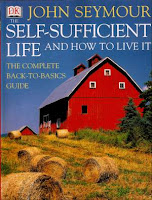 The Self Sufficient Life and How to Live It by John Seymour. Recommended.
Doomer Alert: I have been trying to expand my knowledge of simpler times, in the off chance that peak oil (or any one of the other ulcer-forming scenarios) really does end civilization as we know it. So far this has consisted of checking out a variety of library books on the following topics: gardening, alternative energy sources, food preservation, organic agriculture/horticulture, survival, and overall self sufficiency. Many of these books I found to be of little-to-no use, so I have not been posting reviews. I do believe this book has merit, dear reader, so I thought I would take the time to share it with you.
I will preface this review with the following comments. I doubt that there is any complete self-sufficiency guide. This book comes pretty close to the mark. It spans a wide range of topics and each topic has a good amount of depth. I tend to think of this book as an overarching primer, that would give you a starting point to begin research in each specific arena. (You aren't going to become an expert/competent bee-keeper after reading one page about it) Obviously, each topic most likely has volumes written about it, so to think that one book cold completely cover all the topics that a human would need to be totally self-sufficient is asking a little much. With that said, I will outline the book's many topics:
- Overview of Self-Sufficiency
- Food from the Garden
- Food from Animals
- Food from the Fields
- Food from the Wild
- Dairy Processes
- Kitchen Skills
- Brewing/Winemaking
- Energy and Waste
- Crafts and other skills
- Contacts and References
An Urban Garden
A Community Garden
A One-Acre Farm
A Five-Acre Farm
I also enjoyed the gardening section, which delineated the development of seedlings, planting, and harvesting of many vegetable and fruit varieties. Also of note was the description of small scale farming of grains and root crops in fields, as well as suggestions for crop rotation.
The book shows us there are many things to learn if one was to consider being completely self-sufficient. The main thing I learned was that: I don't want to have to become completely self-sufficient. For some, it may conjure up romantic images of Little House on the Prairie, but honestly, it would stink. I know, people have been doing it for thousands of years; heck, large portions of our population lived this way less than 2 generations ago. I give my respect to those hardy souls, but I would prefer not to be tested in such a way.
Fortunately, I do not think that it is guaranteed (or even really likely) that my family or I will ever be forced to become entirely self-sufficient. This does not mean it is not wise to begin to learn several sets of these skills. If a long term recession/depression hits the US/world, many of these skills could make a huge difference in overall quality of life. So, I will continue to research these topics, and share them with the few folks that happen to stumble upon these words.
Tuesday, July 1, 2008

Wednesday, June 18, 2008
Evaporated Cane Juice

If you ever happen to look at food labels, you may have run across this: "Evaporated Cane Juice"(ECJ). It seems to be commonly found in organic products and other 'health' foods. I noticed it one day, and it got me thinking...how is that different than plain old sugar? Is it really more healthy or are they just trying to pull a fast one on me? So, being the curious fellow I am...I googled it.
Here's what I found:
Basically, Evaporated Cane Juice is sugar that is a little less processed. Wikipedia has a good section on sugar cane processing. There are two schools of thought about ECJ...
1) Any carbohydrates that are less refined are better, and the less refined product has more nutrients
2) The two products are nearly identical in chemical composition, yet not in price...so save your cash
Here are two sources that claim health benefits:
Evaporated cane juice is a healthy alternative to refined sugar. While both sweetners are made from sugar cane, evaporated cane juice does not undergo the same degree of processing that refined sugar does. Therefore, unlike refined sugar, it retains more of the nutrients found in sugar cane.http://www.whfoods.com/genpage.php?tname=foodspice&dbid=120#nutritionalprofile
This site compares many different types of sugar products:
http://www.floridacrystals.com/index.cfm?fuseaction=pages.EvaporatedCaneJuice
Here is a blog that does not believe the benefits out weigh the increased cost:
Evaporated cane juice and plain old sugar are unequivocally the same, α-D-fructofuranosyl β-D-glucopyranoside (aka, sucrose, table sugar).http://webercam.com/2008/04/evaporated-cane-juice-vs-granulated.html
It seems to me that it is very similar to regular sugar. All things being equal, it does have higher amounts of certain nutrients, so it probably is a bit better. The B vitamins that it provides are readily found in many other common foods, however. Organic ECJ seems to be a popular way to sweeten organic products, so environmentally and ecologically it may come out ahead.
I rarely do much baking and do not use very much granulated sugar at all. Since the price is much higher, I probably would not buy ECJ over regular white sugar. However, when checking labels, now I know what the term means and can purchase accordingly.
Other sugar posts:
Evaporated Cane Juice: Part II
High Fructose Corn Syrup
Caramel Apples
Sugar and the Environment
Alternative Sugar Names
A Look at Agave
Where to Buy
Monday, May 19, 2008
www.EatWild.com

Here's a website that provides listings of farms that produce organic foods. You can find organic produce and grass-fed meats near you.
From the site:
Eatwild.com is your source for safe, healthy, natural and nutritious grass-fed beef, lamb, goats, bison, poultry, pork, dairy and other wild edibles.http://www.eatwild.com/
Also see Local Harvest for a great resource for farmer's markets, CSAs, and other local foods.
In Defense of Food
 In Defense of Food: An Eater's Manifesto, Michael Pollan
Could you stand to lose a few pounds? Perhaps just concerned with eating right for health reasons? Have you ever noticed that it seems just about everyday there is a new 'breakthrough scientific study' that claims to have found the holy grail of nutrition? Perhaps it is a low-fat diet...or low-carb...more antioxidants...maybe we just need more omega-3s? Does it seem like a lot of this information tends to contradict previous findings, which in turn, is contradicted again? I found this book to be an eye-opening look into why this has been occurring for over the last century. The author examines the origins of 'Nutritionism'...the phenomenon of applying science and technology to essentially replace our ancestor's food chain with The Western Diet.
Beginning in the early 19th century, scientists discovered the basic building blocks of food: Carbohydrates, Protein and Fat. A little while longer they discovered a few basic nutrients (vitamins) and proclaimed they had solved animal and human nutrition. Soon after, the first baby formula was created (consisting of cow's milk, flour and potassium bicarbonate). Nutritionism was on its way. Unfortunately, doctors began to notice that babies fed exclusively on this diet did not fare especially well...undeterred, the food scientists forged ahead, looking for the magic formula for human nutrition. The author continues to explore the Age of Nutritionism, from the advent of processed grains to the low-fat phenomenon of the late 50s-present to the low-carb craze of the turn of this century. He highlights that current scientists, in some respects, are just like the early ones. There are just far too many things that we just do not know about how the human body utilizes food.
Out of The Age of Nutritionism was born The Western Diet. Highly processed foods, shelf stable and able to be transported around the globe. A plethora of foods sources were distilled into about 4 monoculture grains (corn, soy, wheat, rice) and 3 protein sources (beef, pork and chicken). These staples were then bred for maximum production at low cost (a worthy goal when there are poor, starving people), however this came at a cost of nutritive value and flavor. The author then describes the after affects of the adoption of The Western Diet. After industrialization, native peoples quickly began to contract 'western' diseases (hypertension, diabetes, cancer, etc.) when previously they had very low rates. Pollan describes a study of modern aboriginals who had a wide range of maladies simply disappear after returning to a bush diet for several weeks; foraging for plants, grubs and wild game.
As you may know, the U.S. has very high rates of obesity, hypertension, cancer, and heart disease. Much of the increases in life expectancy have come from preventing infant mortality, not actually extending life spans. In the near future, we may actually see a decrease in life expectancy. Much of this, Pollan argues, is due to our diet. Food scientists can break food down into parts, but it has a harder time putting it back together. And even if they could, do we really know the optimal configuration? Perhaps someday we will...but until then?
What can we do? Must we return to a hunter/gatherer existence to save ourselves? Fortunately, no. The author suggests only simple, basic guidelines: Eat Food, Not Too Much, Mostly Plants. Out of these basic guidelines, there are some sub-bullets I would like to highlight.
- Don't eat anything your great-grandmother wouldn't recognize as food
- Avoid food products that make health claims
- Shop the peripheries of the supermarket, avoid the center aisles
- Eat well-grown food from healthy soils
- Don't look for the magic bullet in traditional diets
- Eat meals, at a table
- Cook...and plant a garden
I would caution that while our diets constitute one portion of our health, it is not the only determinant. Our ancestors also had much different activity levels than we in modern societies do today. I am a strong believer in the power of exercise, which is not in the scope of this book; but in my view, cannot be left out of any discussion of health. I also am an optimist in regards to science. While our scientists may not currently hold the keys to the universe...does that mean we should not implore them to keep looking?
Subscribe to:
Posts (Atom)