
 Posts
Posts


Pan·gloss·i·an 
1. Blindly or naively optimistic.
2. Characterized by or given to extreme optimism, esp. in the face of unrelieved hardship or adversity.
Origin:
1825–35; after Pangloss, an optimistic character in Voltaire's Candide
Wednesday, February 25, 2009
Word of the Day

Tuesday, February 24, 2009
US Budget Quandary

Here's another look at the troubles that we face...there are no easy answers.
The federal tax receipts for 2009 will barely cover the "mandatory" spending."It's not as easy as it sounds. Every president tries to [scrub the budget]. But there's not much low-hanging fruit," said Charles Konigsberg, a former assistant director at OMB in the Clinton administration and now chief budget counsel at the Concord Coalition, a deficit watchdog group.
Here's what Konigsberg means: Roughly two-thirds of the federal budget -- about $2 trillion in 2008 -- is considered mandatory spending. That's money that Uncle Sam has committed to pay out in entitlement programs such as Social Security and Medicare, in interest owed on the national debt, and on other programs for which budget authority is written in stone.
Monday, February 23, 2009
Sunday, February 22, 2009
Made in the USA

Here's an interesting article about what the US produces.
The United States remains by far the world's leading manufacturer by value of goods produced. It hit a record $1.6 trillion in 2007 - nearly double the $811 billion of 1987. For every $1 of value produced in China factories, the United States generates $2.50.
So what is made in the U.S.A. these days?
Saturday, February 21, 2009
New Ag Secretary Tom Vilsack

Obama's new Agriculture secretary has already made some steps to promote local food. First, is a stricter interpretation of a labeling directive in the last farm bill. Mexico and Canada both oppose such "country of origin" labels, since meat packers can now mix US and foreign meat without notifying consumers. I fully support free trade - and have large reservations about 'Buy American' laws. This, however, only gives the consumer information. The consumer can make the choice to support the producer he wishes, rather than being left in the dark.
The labeling requirements, which would apply to fresh meats and some perishable fruits and vegetables, have long been debated in Congress. While the meat industry and retailers responsible for the labels have protested the changes — saying they are burdensome and could lead to higher prices — consumer groups and northern state ranchers who compete with the Canadian beef industry favor them.Another interesting step is to create community garden projects at all USDA facilities worldwide.
During today's ceremony, Secretary Vilsack announced the goal of creating a community garden at each USDA facility worldwide. The USDA community garden project will include a wide variety of garden activities including Embassy window boxes, tree planting, and field office plots. The gardens will be designed to promote "going green" concepts, including landscaping and building design to retain water and reduce runoff; roof gardens for energy efficiency; utilizing native plantings and using sound conservation practices.
...
The garden will showcase conservation practices that all Americans can implement in their own backyards and green spaces. As a component of the garden, pollinator-friendly plantings will not only provide important habitat for bees and butterflies, but can serve as an educational opportunity to help people understand the vital role pollinators play in our food, forage and all agriculture. The garden plot is adjacent to the site of the USDA Farmer's Market.
Tuesday, February 17, 2009
Word of the Day
Pyrrhic victory
1. A victory that is offset by staggering losses
2. A victory or goal achieved at too great a cost
This expression alludes to Kind Pyrrhus of Epirus, who defeated the Romans at Asculum in a.d. 279, but lost his best officers and many of his troops. Pyrrhus then said: "Another such victory and we are lost."
Sunday, February 15, 2009
Personal Savings Rate

As I noted in 'Paradox of Thrift' and is highlighted in this article, the personal savings rate has gotten a lot of attention lately. So how exactly is the personal savings rate calculated?
There are two main sources for the calculation of the personal savings rate (PSR); the U.S. Bureau of Economic Analysis (BEA) estimates it from the National Income and Product Account (NIPA) data, and the Board of Governors (BOG) of the Federal Reserve System estimates the changes in personal net wealth that can be computed from their flow of funds (FoF) accounts.
The PSR value from the BEA is the one most commonly used and quoted in the press. It is calculated by first finding personal savings:
(personal income) - (personal outlays + personal current taxes) = personal savings
This value is then divided by personal income to get the rate.
What exactly is personal income? According to the BEA glossary it is: Income received by persons from all sources. It includes income received from participation in production as well as from government and business transfer payments. It is the sum of compensation of employees (received), supplements to wages and salaries, proprietors' income with inventory valuation adjustment and capital consumption adjustment (CCAdj), rental income of persons with CCAdj, personal income receipts on assets, and personal current transfer receipts, less contributions for government social insurance.
What are personal outlays? From the BEA: The sum of personal consumption expenditures (e.g. the goods and services purchased by persons), personal interest payments, and personal current transfer payments.
Personal current transfer payments are payments consisting of transfer payments by persons to government and to the rest of the world. Payments to government include donations, fees, and fines paid to Federal, state, and local governments, formerly classified as "personal nontax payments."
What about personal taxes? These include taxes paid by persons on income, including realized net capital gains, and on personal property.
The NIPA tables can be found here.
Friday, February 13, 2009
Frontline: Inside the Meltdown
I noticed that the next Frontline on PBS will cover the financial crisis - Inside the Meltdown. Set your Tivos for Tuesday, or catch it online afterwards.
For those struggling to make sense of the economic crisis, help is on the way. Inside the Meltdown is producer Michael Kirk's gripping account of how the country ended up in the worst financial crisis since 1929. The program airs Tuesday night (Feb. 17th) on PBS and will be watchable online after that. This preview excerpt tracks the crisis back upstream to a key source -- the government's failure to heed early warnings on the housing bubble, and the havoc that ensued as a result.
Who is to Blame for the Financial Crisis?

Now is your chance to vote... on Time's pictorial of the 25 personalities most culpable for the financial crisis. There are some familiar faces - and a few less than famous ones - but they all had a hand in the mess we find ourselves. There are too many infamous choices for me to attempt to pick a clear number one, the exercise makes it only more apparent that there is plenty of blame to go around.
Maybe we can all agree it's the crazy octuplet lady's fault.
Thursday, February 12, 2009
Argumentum Ad Consequentiam
Argumentum Ad Consequentiam - a logical fallacy which concludes a certain premise is either true of false based on the (un)desirability of the outcome.
Forms:
- If P, then Q will occur.
- Q is desirable.
- Therefore, P is true.
- If P, then Q will occur.
- Q is undesirable.
- Therefore, P is false.
- This fallacy also falls under the broader "appeal to emotion"
Tuesday, February 10, 2009
Peter Schiff Was Right
These clips come highly recommended from a coworker. Up first...Peter Schiff Was Right:
While past performance is no guarantee of future results, he certainly has my attention after that demonstration of prescience...extra credit for taking Ben Stein to school. Next, check out what he says about the impending stimulus package, if you dare.
The fiscal stimulus bill being debated in Congress not only won't help the economy, it will make the recession much worse, says Peter Schiff, president of Euro Pacific Capital.Nothing like watching a guy call the current situation to the letter, and then have him warn us we are headed to a Weimar Republic.
The problem, he says, is the government is trying to perpetuate a "phony economy" based on borrowing and spending. With the U.S. consumer tapped out, the government is "now taking on the mantle" of consumer of last resort, he continues, predicting the bond bubble will soon burst - if it hasn't already - ultimately leading to a collapse of the dollar and an "inflationary depression worse than anything any of us have ever seen."
Monday, February 9, 2009
The Worst is Yet to Come

Foreignpolicy.com features five articles on the current world financial crisis. It would seem we are not out of the woods yet. In fact, International Monetary Fund chief Dominique Strauss-Kahn said the world's advanced economies -- the U.S., Western Europe and Japan -- are "already in depression,". While the definition of that term is debatable, these five authors delve into more detail...
NORIEL ROUBINIThis crisis is not merely the result of the U.S. housing bubble’s bursting or the collapse of the United States’ subprime mortgage sector. The credit excesses that created this disaster were global. There were many bubbles, and they extended beyond housing in many countries to commercial real estate mortgages and loans, to credit cards, auto loans, and student loans. There were bubbles for the securitized products that converted these loans and mortgages into complex, toxic, and destructive financial instruments. And there were still more bubbles for local government borrowing, leveraged buyouts, hedge funds, commercial and industrial loans, corporate bonds, commodities, and credit-default swaps—a dangerous unregulated market wherein up to $60 trillion of nominal protection was sold against an outstanding stock of corporate bonds of just $6 trillion.
STEPHEN S. ROACHIn the United States, asset-dependent growth was concentrated in two parts of the economy: home-building activity and personal consumption. Sustained weakness is now likely in both sectors, which at their peak accounted for nearly 80 percent of U.S. GDP.
DAVID M. SMICK
That brings export-dependent Asian economies into the equation. In effect, they were driven by export bubbles, which, in turn, were a levered play on the U.S. consumption bubble. Asia was also aided and abetted by sharply undervalued currencies. And to keep their currencies cheap, countries such as China had to recycle massive amounts of foreign exchange reserves into dollar-based assets—suppressing U.S. interest rates and sustaining the very asset and credit bubbles that fueled a bubble-dependent U.S. economy. That virtuous circle has now been broken. And because Asian economies lack vigorous support from internal private consumption, regional growth risks have tipped decisively to the downside.Here’s why this is a huge problem: Developing economies allowed themselves to become dangerously export dependent, while tying their currencies to the U.S. dollar and building mountains of excess savings. That growth model is crumbling fast as global demand is plummeting. But if too many of these emerging markets go down, the IMF lacks the necessary resources to mount rescue operations. To put things in perspective, Austrian banks have emerging-market financial exposure exceeding $290 billion. Austria’s GDP is only $370 billion.
ROBERT J. SHILLER
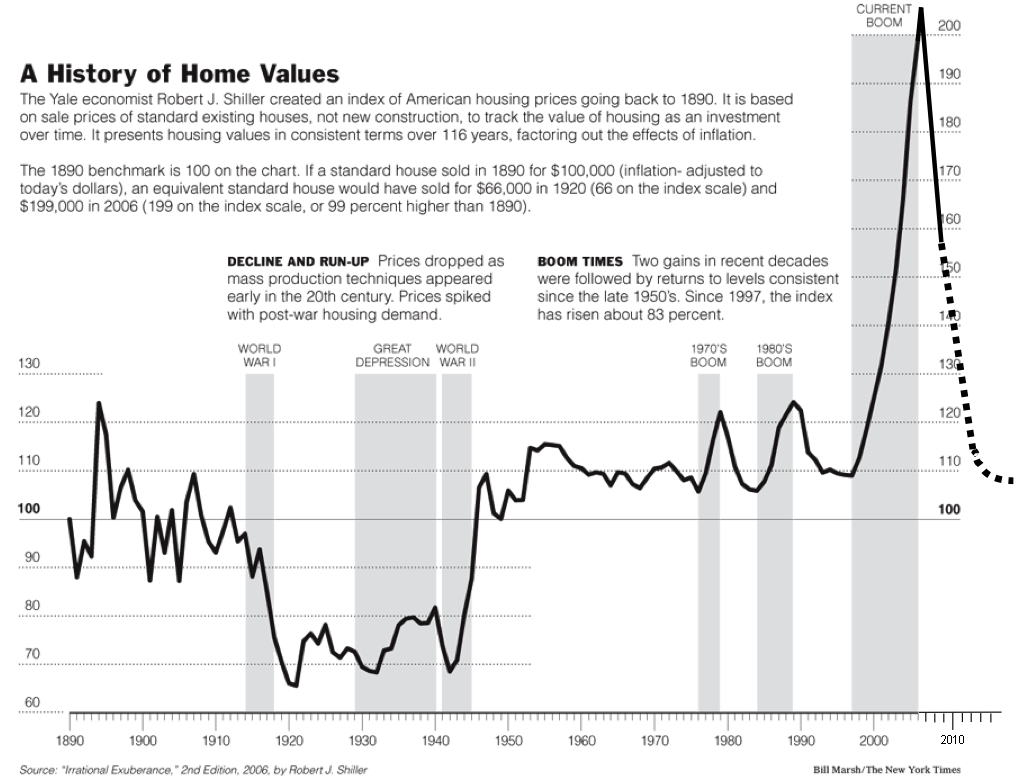
The one silver lining is that the world does not lack capital. It’s simply sitting on the sidelines, including $6 trillion in global money market funds alone. The faster Obama and his global counterparts can fashion credible financial reforms that enhance transparency while preserving capital and trade flows, the sooner that sidelined capital will reengage. In the end, markets crave certainty—in this case, certainty that our leaders have a credible game plan. That plan is not yet in place.So far, the measures we’ve taken to resolve this crisis have thrown the rational principles of finance out the window. We are going on a crash diet—contradicting mortgage contracts on an ad hoc basis and giving away handfuls of money—when we should be coming up with an eating regime we can live on indefinitely. Instead of making whatever short-term patches seem necessary, we might take a more systemic, market-based approach, such as stipulating that mortgage values always be linked to housing prices and adjusted each month.
DEAN BAKER
Speculative excesses are an endemic problem of the market system, but capitalism also provides its own self-correcting mechanisms. There’s no reason to abandon those tools now.But once the financial situation begins to return to normal (which might not be in 2009), investors will be unhappy with the extremely low returns available from dollar assets. Their exodus will cause the dollar to resume the fall it began in 2002, but this time, its decline might be far more rapid. Other countries, most notably China, will be much less dependent on the U.S. market for their exports and will have less interest in propping up the dollar.
For Americans, the effect of a sharp decline in the dollar will be considerably higher import prices and a reduced standard of living. If the U.S. Federal Reserve becomes concerned about the inflation resulting from higher import prices, it might raise interest rates, which could lead to another severe hit to the economy.
Sunday, February 8, 2009
Word of the Day
schadenfreude
 nˌfrɔɪ
German: Schaden (damage, harm) and Freude (joy)
1. enjoyment obtained from the troubles of others
2. satisfaction or pleasure felt at someone else's misfortune1. enjoyment obtained from the troubles of others
See also: Roman Holiday
Saturday, February 7, 2009
Peanut Butter Recall Update
As the peanut butter recall expands, it is beginning to appear that the Salmonella outbreak was more than an accident. It had been reported that the Peanut Corporation of America had shipped products that had previously been positive for Salmonella but then had retested negative. This is bad enough, but now this article claims that they even sent out product without retesting...thus they knowingly and intentionally sent out tainted peanut products.
"In some situations the firm received a positive salmonella test result, followed by a later negative result, and then shipped the products," said the FDA report, which was included in an e-mail to CNN. "In some other situations, the firm shipped the products [which had already tested positive] before it had received the [second] positive test results."
In some cases, it said, "no additional testing appears to have been done."
No one from the company returned a call seeking comment.
Federal authorities have initiated a criminal investigation into the company.
Subscribe to:
Posts (Atom)