
 Posts
Posts


It has been about a month since my last hypermiling update. Two out of the three tanks were sub-par...I blame heavier traffic due to a slight change in commute, as well as occasional AC use. Even so, they were not horrible tanks, and my fill up today was a near record.
Updated overall stats for hypermiling (since 2/4/08):
Fuel price chart: I was surprised to see that gas had actually decreased in price since my last fill up. Not to rub it in, but you'll notice that I have yet to pay over $4.00 per gallon.
Friday, July 11, 2008
Hypermiling Update: 7/11/08

Thursday, July 10, 2008
Creepy Trick From 'The Dude'
http://www.jeffbridges.com/images/somethingtodo1.gif
Oh yeah, and go see Iron Man...
Salmonella Update

The latest report on the Salmonella 'outbreak':
http://edition.cnn.com/2008/HEALTH/conditions/07/09/salmonella.tomatoes.ap/
I turns out is definitely is not solely tomatoes, yet not jalapeños alone either:
Poor Serrano peppers...they get thrown into the mix because of a case of mistaken identity.Raw jalapenos caused some of the illnesses, conclude CDC investigations of two clusters of sick people who ate at the same restaurant or catered event.
But jalapenos cannot be the sole culprit -- because many of the ill insist they didn't eat hot peppers or foods like salsa that contain them, CDC food safety chief Dr. Robert Tauxe told The Associated Press. As for serrano peppers, that was included in the warning because they're difficult for consumers to tell apart.
I wonder if reported cases are increasing due to increased media coverage. Perhaps there are this many people always getting sick and simply not reporting it. I tend to get a 'stomach flu' every now and then, yet never get tested for food borne pathogens. Perhaps I should reconsider...
Wednesday, July 9, 2008
Pickens' Plan

As I noted in this post, Texas billionaire T. Boone Pickens has some ideas on how to break our addiction of foreign oil. His 'Pickens' Plan' outlines how. He primarily is resting our hopes on wind energy and domestic natural gas. Since these alternatives have drawbacks, it is important to remember that this plan is a stop gap measure to buy us time.
I am not extremely familiar with our natural gas reserves...I believe they are primarily used for home heating and peak demand electricity generation. It is also used in industry, shale oil recovery and ethanol production. I am unsure of the ramifications of large scale transportation demand on our natural gas supplies. Saudi Arabia has large natural gas reserves, but shipping it requires pipeline or liquidation infrastructure.The Pickens Plan is a bridge to the future — a blueprint to reduce foreign oil dependence by harnessing domestic energy alternatives, and buy us time to develop even greater new technologies.
Building new wind generation facilities and better utilizing our natural gas resources can replace more than one-third of our foreign oil imports in 10 years. But it will take leadership.
As for wind...it is great, and becoming competitive with other electricity sources. But as I noted in this post, it cannot cover very much of our demand in the near term.
What are your views of his plan?
What is your plan?
Monday, July 7, 2008
The Other 'Black Gold'

Compost. Claire Foster. Recommended.
As I recently mentioned in the Self-Sufficient Life post, there are many topics and skills that may be beneficial to learn, and most are complex enough to warrant their own book (maybe several) and perhaps a lot of trial and error to become proficient. This topic is fairly straight forward, yet has some nuances that I discovered in this book.
This particular book is a great little primer that pretty much tells you everything you need to know about creating your own compost. First, let's review some of the benefits:
- Recycles organic waste
- Reduces landfill pressure
- Organically increases soil productivity
- Lessens need for chemical fertilizers
- Nutrient dense
- Saves money
If done correctly, the few drawbacks (odor, unsightliness, animals) can be pretty much eliminated. This book will help you to do just that.
After covering the basics, the author delves into soil science for two chapters. Physical and chemical composition of soil is covered in quick, yet informative prose. The next chapter covers exactly what ingredients you should and should not use in your compost concoction. Compost bin and container design is then examined in good detail, giving pros and cons for many types of applications and situations. Finally, the author outlines the prevailing methods for combining your ingredients and container, as well as maintenance of your pile. Worm composters and green manure are also covered in slight detail.
This is a great reference for composting. It is short (abt 100 pgs) and to the point, but holds many good ideas and tips that will increase the productivity of your composting experience. The moral of the story: there is no right or wrong way to compost, and it will take care of itself in most cases. If you wish to speed up and maximize the process, this book will help you.
 I have had a simple compost pile for several years now. This year I upgraded to a commercial plastic bin. It certainly allows for a larger amount of material to be processed, mostly due to the increased heat and improved geometry. By the end of the year, I should have quite a large amount to improve my soil.
Sunday, July 6, 2008
I Think It's the Salsa

As mentioned in this and this post, the North American Salmonella outbreak is confounding FDA investigators. They are scouring fields, packing and shipping facilities; taking samples of water, soil and fruit. Still, there is no smoking gun...
But the U.S. Food and Drug Administration appears no closer to finding the source of a mysterious salmonella outbreak that has sickened more than 900 people nationwide.Due to FDA halting tomato shipments and since many restaurants have simply stopped serving them altogether, the bottom has dropped out of the market. In both U.S. and Mexico, tomato growers are losing many millions of dollars as their crops sit to rot in fields or warehouses. Now this concern will no doubt spread to the pepper and herb growers as well.The FDA is not even 100 percent sure that tomatoes are the cause — adding peppers and cilantro Saturday to its list of foods under investigation in the outbreak.
And for those who forgot the cause for the alarm:
Salmonella can be transmitted to humans when fecal material from animals or humans contaminates food. Fever, diarrhea and abdominal cramps typically start eight to 48 hours after infection and can last a week. Many people recover without treatment. But severe infection and death are possible. At least 130 people have been hospitalized in this outbreak, the CDC says.Mmmm. I wish the FDA inspectors the best of luck in this tricky and expanding situation.
Saturday, July 5, 2008
Lock in the Freshness
 Ball Blue Book - Guide to Home Canning, Freezing & Dehydration. Recommended.
Anyone that has a garden of any appreciable size quickly realizes that bumper crops can be a mixed blessing. The large abundance normally comes in a very short window of time, leaving the gardener to either allow their harvest to go to waste, share with friends (who may have an overstock as well), or preserve for later use. Of course, anyone who is planning on surviving solely on his own produce must preserve food for the winter and other times of need. Even those who wish to only supplement their diets with homegrown food are better served with a skill set to preserve their harvest.
The Ball Blue Book, originally published in 1909, is a 'bible' of sorts for home food preservation. It not only covers canning, but many other techniques such as: jams and jellies, pickling, freezing and drying. The instructions and recipes are very descriptive and informative. There are many recipes that may give you ideas on how to use your various produce in new and exciting ways.
I'll admit that I have not had a chance to use many of the recipes yet. I did use it for a reference while freezing some extra sweet corn from the farmer's market. This year's garden is not as productive as previous years, so I will not have as many opportunities for food preservation. Next year, I plan on having a larger spread, along with an increase in fruit and berry output. I will be adding this book to my reference library to handle this excess production.
The Self-Sufficient Life
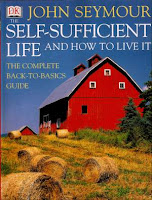 The Self Sufficient Life and How to Live It by John Seymour. Recommended.
Doomer Alert: I have been trying to expand my knowledge of simpler times, in the off chance that peak oil (or any one of the other ulcer-forming scenarios) really does end civilization as we know it. So far this has consisted of checking out a variety of library books on the following topics: gardening, alternative energy sources, food preservation, organic agriculture/horticulture, survival, and overall self sufficiency. Many of these books I found to be of little-to-no use, so I have not been posting reviews. I do believe this book has merit, dear reader, so I thought I would take the time to share it with you.
I will preface this review with the following comments. I doubt that there is any complete self-sufficiency guide. This book comes pretty close to the mark. It spans a wide range of topics and each topic has a good amount of depth. I tend to think of this book as an overarching primer, that would give you a starting point to begin research in each specific arena. (You aren't going to become an expert/competent bee-keeper after reading one page about it) Obviously, each topic most likely has volumes written about it, so to think that one book cold completely cover all the topics that a human would need to be totally self-sufficient is asking a little much. With that said, I will outline the book's many topics:
- Overview of Self-Sufficiency
- Food from the Garden
- Food from Animals
- Food from the Fields
- Food from the Wild
- Dairy Processes
- Kitchen Skills
- Brewing/Winemaking
- Energy and Waste
- Crafts and other skills
- Contacts and References
An Urban Garden
A Community Garden
A One-Acre Farm
A Five-Acre Farm
I also enjoyed the gardening section, which delineated the development of seedlings, planting, and harvesting of many vegetable and fruit varieties. Also of note was the description of small scale farming of grains and root crops in fields, as well as suggestions for crop rotation.
The book shows us there are many things to learn if one was to consider being completely self-sufficient. The main thing I learned was that: I don't want to have to become completely self-sufficient. For some, it may conjure up romantic images of Little House on the Prairie, but honestly, it would stink. I know, people have been doing it for thousands of years; heck, large portions of our population lived this way less than 2 generations ago. I give my respect to those hardy souls, but I would prefer not to be tested in such a way.
Fortunately, I do not think that it is guaranteed (or even really likely) that my family or I will ever be forced to become entirely self-sufficient. This does not mean it is not wise to begin to learn several sets of these skills. If a long term recession/depression hits the US/world, many of these skills could make a huge difference in overall quality of life. So, I will continue to research these topics, and share them with the few folks that happen to stumble upon these words.
Friday, July 4, 2008
Hypermiling is Dangerous, AAA: Debunked

You may have heard that the American Automobile Association has recently come out with a press release claiming there are many dangers associated with Hypermiling. CleanMPG.com has taken exception to this negative attention and released a statement of clarification. This rebuttal statement can be found here:
Response to AAA'S 6/27/2008 "Hypermiling is Dangerous" Press Release
Certainly some of the more extreme techniques could be considered dangerous, but painting all Hypermilers in this light is counterproductive. I think the main thing to take away is that everyone agrees on the following recommendations:
Some the AAA's recommendations are listed on CleanMPG as a good starting point: smooth and gentle acceleration and braking, maintaining a steady speed, using cruise control, and looking ahead to anticipate changing traffic conditions. Incidentally, cruise control is less efficient than other methods but it is an excellent tool to break the speeding habit.Just following these basic guidelines will show massive increases in your fuel economy. As for the safety aspect...I have noticed that I am much more attentive driver while concentrating on maximizing fuel economy. I must focus on upcoming traffic and signals...and cannot afford to be preoccupied on a cell phone. An attentive driver is a safer driver in my opinion.
7 Dollar Gas?

Here's a little more pessimism for you. This report, by CIBC World Markets, predicts $150-200/barrel oil and $6-7.00 gasoline in the next two years. The report also predicts that these prices will remove millions of cars from the roads; primarily older, less fuel efficient vehicles owned by the poor.
As gasoline prices climb inexorably, American driving habits are going to have to undergo a massive change, mimicking the driving habits long adopted by Europeans who have faced much higher gas prices. Average miles driven will likely fall by as much as 15%, while the market share of light trucks, SUVs and vans will be literally halved, reversing the trend of the last fifteen years. But the most fundamental, and unprecedented change will be in the number of vehicles on the road.The article also touches on alternatives, mainly public transportation. We in America have loathed public transportation. There are many reasons for this. For one, we enjoy our freedom...to travel when, where, how and with whom we so choose. As this luxury becomes more expensive, many of us will no longer be able to have this freedom. The question then becomes, "Will we have any alternatives?".
Over the next four years, we are likely to witness the greatest mass exodus of vehicles off America’s highways in history. By 2012, there should be some 10 million fewer vehicles on American roadways than there are today—a decline that dwarfs all previous adjustments including those during the two OPEC oil shocks (see pages 4-8). Many of those in the exit lane will be low income Americans from households earning less than $25,000 per year. Incredibly, over 10 million of those American households own more than one car.
Soon they won’t own any.
Is this a realistic estimate? While $7 per gallon gasoline prices certainly took people off the road in Europe, you cannot simply impose Europe on America. MostI agree with this assessment, and also offer this observation. Sure, we have invested heavily in roads rather than rail...we have made our bed and now must lay in it...but, population densities are much higher in Europe. We can leverage public transportation in high density areas, but the rural poor will have much fewer options. Well managed, sensible public transportation should be part of the solution, but it will only be a portion. We must employ a wide range of alternatives to keep our nation strong.
Europeans have access to public transport by virtue of the broad infrastructure policies European countries have pursued. In marked contrast, America built massive highways and freeways for a population that owned and used their own cars to get around.
Hence we must narrow our focus on those Americans where a European style shift in driving habits is currently feasible. People can’t simply abandon their cars if they
have no other means of getting around, particularly in terms of getting work. There must be at least a public transport alternative.
Thursday, July 3, 2008
DOGSHOW

Oscar qualified for the "Most Handsome Dog in the World" prize recently. After receiving numerous complaints on what a handsome pup we own, I decided to amass more attention. They do not get much better than this.
Give 'Em the Boot


My garden is a little behind due to the area's less than optimal planting season. None the less, I'm excited to see how the tomatoes do in their respective pots. I've had little success growing tomatoes in these conditions the past two years; usually ending their lives with small fruit and blossom end rot.
I have several varieties of basil and peppers.
THE BOOT was purchased at Home Depot. It's about 2-3 feet tall and contains a variety of campanula. I am excited to see how the plant thrives in THE BOOT. THE BOOT makes for an interesting conversation piece. Most people think I am squirrely.
Wednesday, July 2, 2008
Tango and Cash
 Here's an interesting little vehicle that will definitely turn some heads...the Tango T600. If you are of the impression that electric vehicles are only beefed-up golf carts, this little guy might change your mind. It is small enough for split-lane driving (where legal), meaning you can drive in between stopped vehicles in a traffic jam.
With a top speed of 150 mph and 0-60 in 4 seconds it surely has some performance credentials. However, with a $108,000 price tag (for the kit), the Tesla Roadster seems like a much better choice.
Tango Brochure
IEA Issues New Pessimistic Oil Outlook

Here is the press release from the International Energy Agency's latest Medium-Term Oil Market Report. (It appears the actual report costs 400 Euro, so I won't be commenting on that)
Some interesting highlights:
Supply
Supply growth deriving from a concentration of new project start-ups during 2008-2010, allied to weaker economic growth, sees potential spare capacity rise in excess of 4 mb/d. However, this expansion slows from 2011 onwards when global demand growth recovers, leading to a narrowing of spare capacity to minimal levels by 2013. Since the 2007 MTOMR, significant downward revisions have been made to both non-OPEC supplies and OPEC capacity forecasts. Project delays averaging 12 months, coupled with global average decline of 5.2% - up from 4% last year – are the factors behind these revisions. Over 3.5 mb/d of new production will be needed each year just to hold global production steady. “Our findings highlight again the need for sustained, and indeed, increased investment both upstream and downstream -- to assure that the market is adequately supplied,” stated Mr. Tanaka.
Biofuels
Although biofuels will add to supply growth, increasing from 1.35 mb/d in 2008 to 1.95 mb/d by 2013, announced capacity additions may be difficult to achieve given available feedstock and growing concerns due to rising food prices. “Biofuels have helped to diversify energy supply. They cannot be blamed for all of the increase in grain prices, even if they have had an impact. However, we remain cautious in regard to the future growth of 1st generation biofuels as there will be growing competition for feedstocks and we see increased difficulties to expansion of biofuels in some places,” said Mr. Tanaka.
DemandThese are not comforting messages. These, along with comments earlier this week by OPEC leaders about $170-180/barrel oil, seem to lend credence to the opinion that gas prices are not going down any time soon. ...Not to mention the increased tension with Iran. Just when I start to get a little optimistic...
Global demand for oil products will grow by an average of 1.6% per year to 2013, from 86.9 mb/d in 2008 to 94.1 mb/d. ... “Developing countries will drive demand growth, their total consumption equalling that of mature economies by 2015.” Asia, the Middle East and Latin America will account for nearly 90% of demand growth over the five-year forecast period.


Subscribe to:
Posts (Atom)